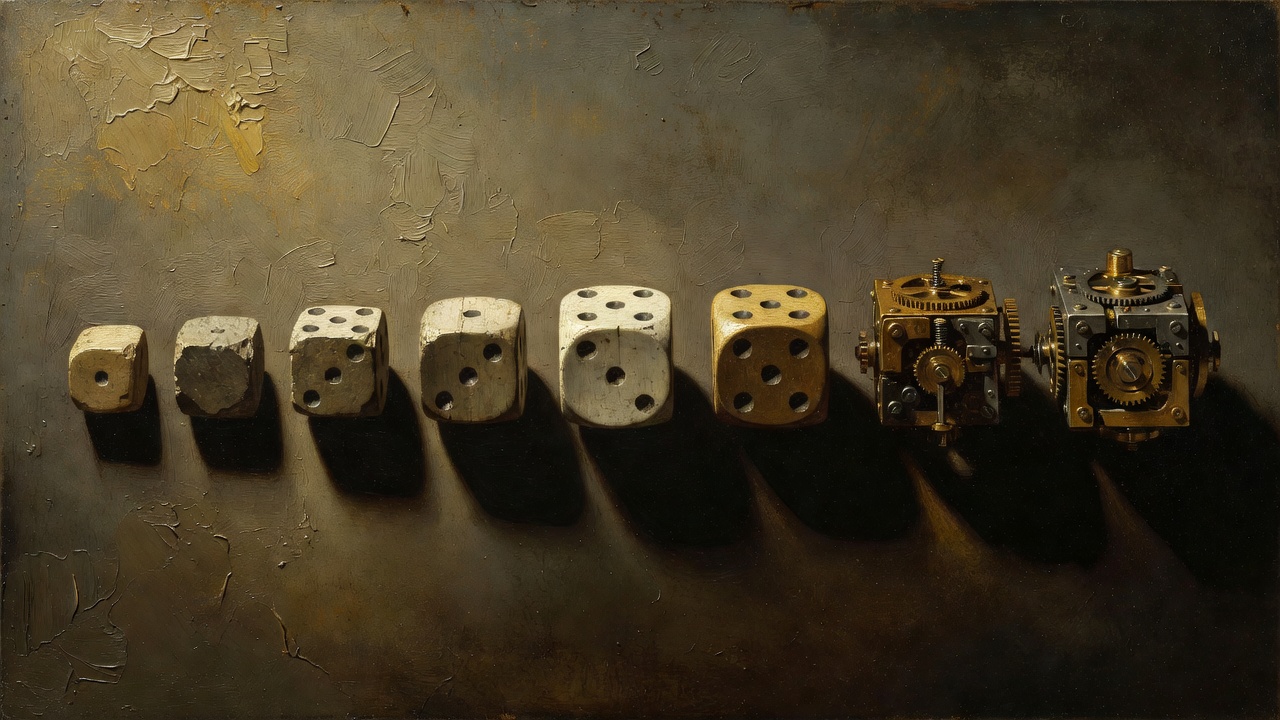
Craps evolved from the English game of Hazard, documented in records dating to the 1600s. The American adaptation, abbreviated to "Craps," became widespread in New Orleans during the early 19th century, particularly among enslaved and working-class populations. No licensing existed. No regulators existed. The game moved from street to parlor as wealth increased.
1910-1950: The Prohibition and Private Club Era
1910-1950: The Prohibition and Private Club Era. Gaming was explicitly illegal in most U.S. jurisdictions during Prohibition (1920-1933) and remained restricted thereafter. Craps persisted in underground rooms and private clubs operating outside regulatory authority. Law enforcement treated craps games as felonies. Operators ran the game for the vigorish, the house cut on bets, which was typically 5 to 16 percent depending on the jurisdiction and the operator's tolerance for risk.
1950-1970: Nevada Licensing Begins. Nevada legalized casino gaming in 1931 but did not establish rigorous licensing until the 1950s. The Nevada Gaming Commission, created in 1955, imposed controls: game rules, payout tables, operator background checks, quarterly audits. Craps tables had to meet specifications. The stick (house employee managing proposition bets), the boxman (supervising the stick), and the two dealers became standardized roles. The house edge was fixed at certain percentages depending on the bet type. The game could no longer be run on whim.
1970-1990: Atlantic City and Interstate Expansion. New Jersey legalized gaming in Atlantic City in 1976 and created the Division of Gaming Enforcement (DGE), modeled on Nevada's system but with stricter capital requirements and minority-ownership rules. Other U.S. jurisdictions followed. Craps tables became subject to state-level technical standards: the layout print, the felt specifications, the dice weight and dimension tolerances. A craps die had to be 3/4 inch on each side, plus or minus 1/64 inch. The phrase "tight craps" emerged, meaning a game with minimal house advantage because the table was carefully maintained and overseen. Regulation had standardized the game to the point where a player's expected loss became predictable.
1990-2010: Online and Tribal Gaming. Tribal gaming compacts on Native American land introduced new regulatory regimes. Some tribes licensed craps games with lower house edges to compete with state casinos; others did not offer craps at all. Online gaming, emerging in the 1990s, operated mostly outside U.S. jurisdiction until the Unlawful Internet Gambling Enforcement Act of 2006 restricted payments to offshore operators. Craps remained a niche online offering because the game's appeal is partly tactile: throwing dice, feeling the weight, hearing the collective reaction. Software-based craps, while mathematically equivalent, did not capture that appeal.
2010-Present: Standardized Global Licensing. The Malta Gaming Authority (established 2001), the UK Gambling Commission (established 2007), and Curaçao eGaming each now license craps variants. All licensed versions have fixed rules, verified RTPs (return to player, the inverse of house edge), and regular third-party audits. The game is no longer evolving tactically. It has been formalized. A player in Malta sees the same game structure as a player in Atlantic City or Las Vegas, because all are regulated under equivalent standards.
The regulatory arc of craps mirrors the maturation of gaming itself. An underground game with no rules became a licensed game with fixed rules became an internationally regulated product with harmonized standards. Regulatory status shifted from criminal to tolerated to licensed to normalized. The game's mechanics have not changed. Its legal status has changed completely.