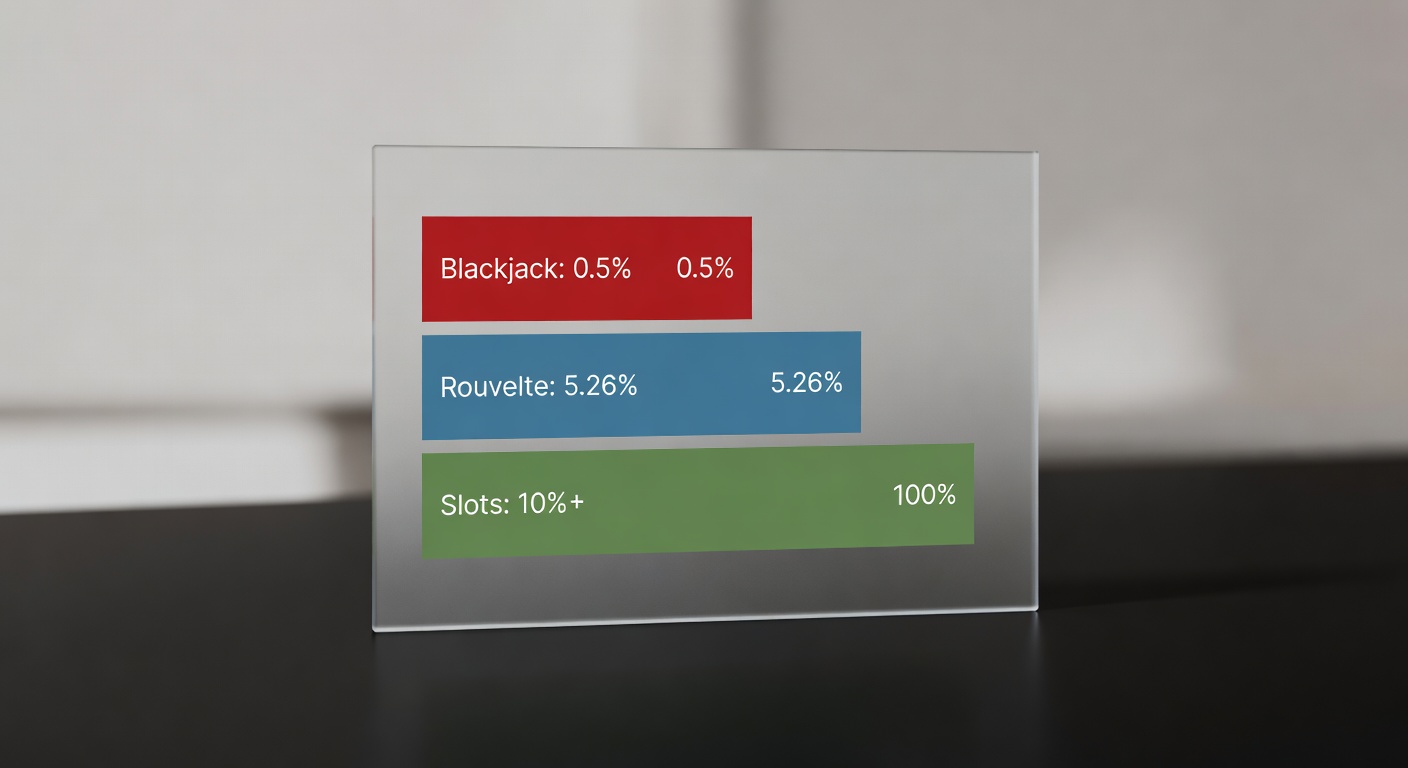
Every casino lists house edge somewhere in the fine print. Baccarat: 1.06 percent. Blackjack: 0.5 percent. Craps: 1.4 percent. What these numbers mean and what they mean for your wallet are not the same thing.
House edge is a mathematical construct. It's the average percentage the casino wins on every dollar you wager over infinite hands. But you don't have infinite hands. You have a night, a trip, or a few hours on a Tuesday afternoon. The gap between the theoretical edge and your actual loss is called variance, and it's the entire reason you show up.
Blackjack vs Baccarat
Blackjack advertises 0.5 percent house edge if you play perfect basic strategy. DraftKings live blackjack, Pragmatic Play, and Evolution all publish this. The catch: most players deviate from basic strategy on at least 15 percent of hands. A player who splits tens or doubles 5-6 against a dealer six just cost themselves another 1 to 2 percent. You think you're playing a 0.5 percent game. You're playing a 2 percent game.
Baccarat has a 1.06 percent edge on banker bets, 1.24 percent on player bets. But banker and player are coin-flips with a house skim. There's no strategy. There's no decision point that costs you chips. You pick a side, it happens, the house takes its cut. Over four hours of 40 hands per hour (flat betting 100 dollars), blackjack basic-strategy players expect to lose about 40 dollars (0.5 percent of 8,000 wagered). Baccarat players over the same stretch expect to lose about 85 dollars on banker bets (1.06 percent of 8,000).
But here's the invisible part: blackjack requires active decision-making. Baccarat doesn't. Fatigue-induced errors in blackjack cost you more than the stated edge. Baccarat's mechanical nature means you won't deviation-bomb yourself. The 0.5 percent vs 1.06 percent gap shrinks when you account for player error.
Roulette's Honest Brutality
American roulette with a double zero carries a 5.26 percent house edge. This is the cleanest statement casinos make. On 36 spins at 100 dollars per spin, you expect to lose 189 dollars. No decision points. No strategy. No way to think yourself into being right. The house takes $3,600 in total action, keeps $189.
European roulette with one zero: 2.70 percent. French roulette with en prison rules (bet is held if zero hits): 1.35 percent on even-money bets. You're not getting better odds. You're getting better rules. Same wheel, different math.
Roulette players know what they're getting. The edge is transparent. It's also enormous compared to table games with skill components.
Craps: The Deceptive Multiplier
Craps advertises 1.4 percent on the pass line and 1.40 percent on the don't pass. These are the bets everyone makes. But the game offers other propositions: hardways at 9.09 percent, field bets at 2.78 percent, proposition bets in the center at 11 to 16 percent.
I watched a craps session at the Venetian for two hours. The player making pass line bets won six of twelve rolls. Pass line edge: 1.4 percent. But same player made twelve hardway bets, lost ten of them. Hardway edge: 9.09 percent. The casino marketed the game on its 1.4 percent line edge and extracted 9.09 percent off proposition action. This is how casinos use numbers. They quote the best edge, hope you play the worst bets.
The Ranked List
Ranking by actual player odds if you stick to best-case betting:
- Blackjack: 0.5 percent (assuming perfect basic strategy and no drunk deviations)
- Craps: 1.4 percent (pass line, don't pass, come bets only)
- Baccarat: 1.06 percent (banker bets only)
- French Roulette: 1.35 percent (en prison rules)
- European Roulette: 2.70 percent (no en prison)
- American Roulette: 5.26 percent
What matters: the edge is only the expectation. Over a few hours, variance dominates. You can lose 1,000 dollars on a 0.5 percent blackjack game. You can win 500 dollars on a 5.26 percent roulette run. The house edge is the anchor point. Your actual result is anchored to it over time. Pick the table with the lowest edge you can find, play flat (no increasing bets after losses), and treat your loss limit as your budget, not your buy-in.