The Start: 1905-1930
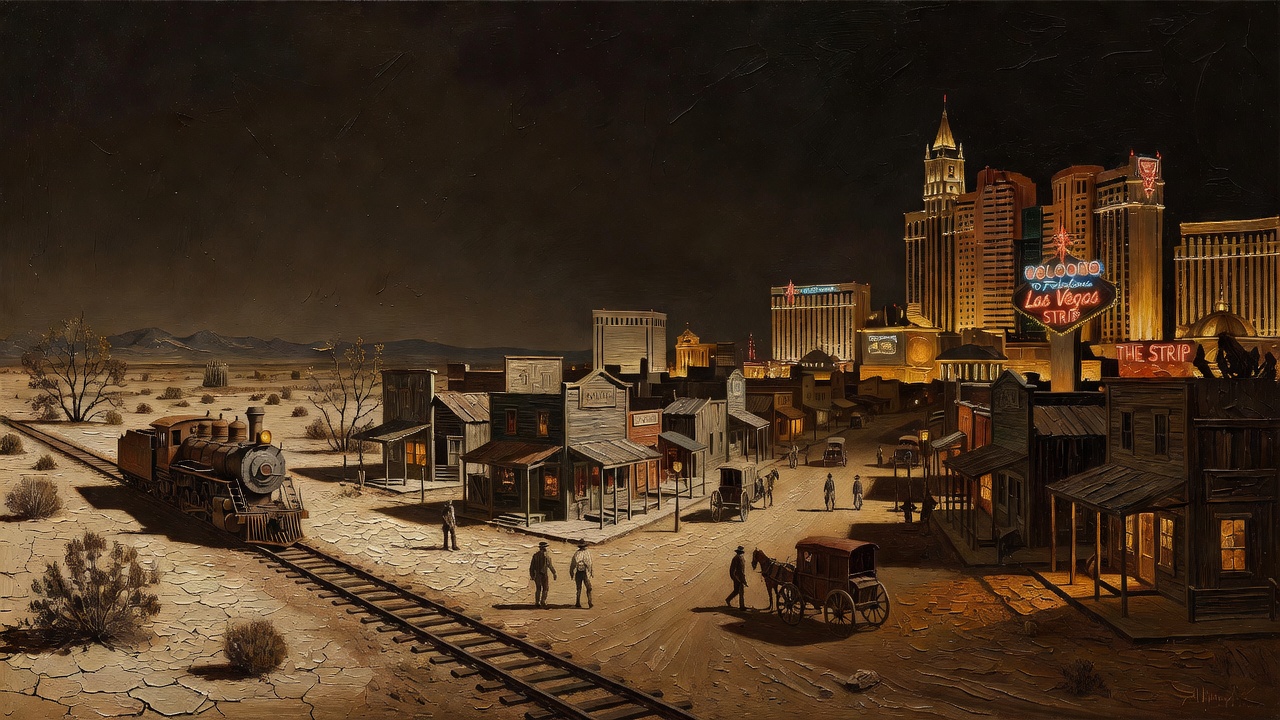
Las Vegas begins with the railroad. The San Pedro, Los Angeles and Salt Lake Railroad laid track through the Nevada desert in 1902. Water stops were needed. In 1905, Las Vegas was officially founded. Population: a few hundred. Economy: railroad workers.
It was dust. Honest dust. People moved through. Some stayed. The town existed because the railroad needed it to exist.
In 1931, Nevada legalized gambling. Not as a moral stance. As an economic decision. The state needed money. Gambling brought money. Casinos opened. They were small. Crude. Functional.
The Transition: 1931-1960
Young guys saw opportunity. Not just gambling, but the infrastructure of gambling. Hotels, restaurants, entertainment. You could build a machine that made money from other people's desire to risk.
Bugsy Siegel built the Flamingo in 1946, with mob money, in the middle of the desert where no rational person would build a casino. But he understood something: people would travel for the experience. Create an oasis in the desert, make them feel like they're somewhere special, they'll spend their money there.
The casinos got bigger. The hotels got nicer. Stars performed. Frank Sinatra. Sammy Davis Jr. The Rat Pack made Vegas cool.
Money flowed. A lot of it was mob money. Most of it was legitimate business money being skimmed by people with connections. The system worked because nobody was watching carefully.
The Growth: 1960-1990
Vegas became a destination. Not just for gambling, but for the idea of Vegas. Anything you wanted was available. No judgment. No history. You could be someone else for a weekend.
Howard Hughes bought the Flamingo, then the Sands, then dozens of other properties. He was legitimizing the city by giving it a billionaire investor. The corporate era began. Corporations understood efficiency, scale, compliance.
But the core remained unchanged: a machine designed to extract money from people who came to gamble.
The Strip expanded. New casinos got bigger and flashier. The Mirage with its volcano. The Bellagio with its fountains. Caesars Palace with its columns. Each one was designed to be an experience, a reason to visit, a place to lose money in style.
The Boom: 1990-Present
Vegas stopped being just a gambling town. It became an entertainment destination. Sure, the money was still in gambling. But the marketing was in the spectacle.
You could see a fight in Vegas. A concert. A show with production that cost millions. You could eat at restaurants with three-star chefs. You could pretend to be someone else because the city was designed for that pretense.
The money machine became more efficient. Slot machines got better. Table game theory got more sophisticated. Hotel rooms, restaurants, entertainment, all designed to keep you in the casino, keep you spending, keep you coming back.
The Present
Vegas today is the fully refined version of what Bugsy Siegel understood: create an environment where people come to spend money, make sure they feel like the experience is worth it, and design everything to extract that money efficiently.
The evolution is complete. Vegas started as a railroad town. It became a gambling town. It became a criminal town. It became a corporate town. It became an entertainment experience.
But underneath all of it, the fundamental machine remains the same. Money in. Odds against you. Money goes to the house. The design is just prettier now.