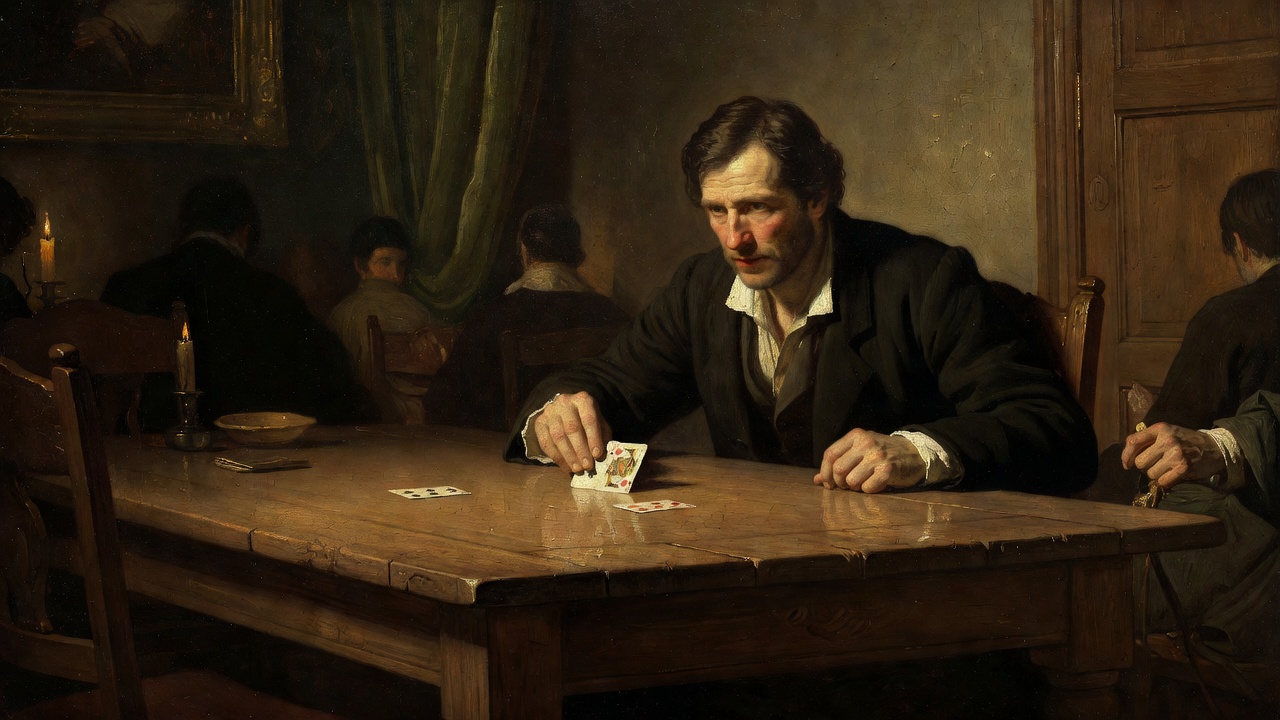
The Setup
It was December 2011. A Thursday evening in Las Vegas. The Venetian showroom had gone quiet in that way poker rooms go quiet when something dangerous is about to happen. Tom Dwan and Brandon Adams were heads-up on the final table of a high roller event, and the pot had grown to $127,000. The blinds were $600 and $1,200. Adams raised to $3,600 from the button. Dwan called.
The flop came Qh-8d-3s. Dwan checked. Adams bet $4,200. Dwan called.
The turn brought a 7h. Dwan checked again. Adams fired again, $8,400 into a pot of $12,000. The math was ugly for a marginal hand: he needed to win the pot nearly 60 percent of the time just to break even on the bet.
Dwan held 10-5 offsuit. Nothing. No pair, no draw, no history with Adams, no position advantage. Just ten and five. In the next ten seconds, the entire evening would turn on whether Dwan believed what his opponent's betting pattern was actually telling him.
He called.
The river came the 2c. Adams checked. Dwan bet $12,000. Adams folded, and the pot moved across the felt to Dwan.
The Reading
What makes a hero call heroic isn't the cards. It's the judgment. The ability to sit still for a moment and let your pattern-recognition system separate the signal from the noise. Dwan had built his reputation on these instants: the ability to see through the performance of poker into the truth beneath it.
Hero calls have a mathematical component, sure. But they're fundamentally about psychology. They're about understanding that every action at the table communicates something, and most players are terrible at lying. Adams had bet the flop and turn in a way that suggested a medium pair or a marginal draw, something that needed protection but not enough equity to go all-in. Dwan's read was that Adams was betting the texture, not the strength. That he was playing the board, not the cards.
The thing about hero calls is they look simple in retrospect. But they're only made by players who have spent thousands of hours listening to what the table is saying without the ego-filter that turns most amateur poker into tribal combat.
"Reading someone isn't magic. It's just remembering that everyone at the table is scared. You're scared too. The person who can hold that fear steady and still think clearly wins the pot."
The Classics
There are other calls that have lived in poker memory longer. In 1994, at the World Series of Poker Main Event final table, Russ Hamilton called a massive river bet from Duncan Fowler with just ace-high. Fowler had missed a flush draw. The call took three minutes and saved Hamilton's stack in a hand that would eventually lead to his tournament victory.
Or consider the call made by Phil Ivey against Vanessa Selbst at the Aria in 2010, where Ivey called a river shove on the bubble with a hand he had thought was a bluff. The card that hit the river changed the entire texture of the hand. Ivey had read that Selbst was using the size of her bet to compensate for the strength she actually held, a tell that smaller players often miss because it requires you to watch long enough to notice the inverse correlation between aggression and hand strength.
What these calls have in common is that they required the player to sit still with uncertainty. To feel the fear and call anyway.
The Practice
Hero calls aren't taught in most poker training. You can't learn them from a book because they depend entirely on the texture of a specific moment, the history between two specific opponents, the state of the economy of the table, and the meta-state of the players themselves. They're the difference between playing poker and understanding poker.
The infrastructure for developing this skill has changed. Solvers have made optimal play quantifiable. But solvers can't make hero calls, because hero calls are, by definition, exploitative plays that work only against opponents who are deviating from optimal. A solver would fold 10-5 in that spot. A solver would call with a tighter range based on Dwan's tendency to bluff a certain percentage of the time in that exact configuration.
But Dwan wasn't solving. He was reading.
That skill comes from volume. From playing ten thousand hands and seeing how people behave when they're scared, when they're trapped, when they're trying to represent something they don't have. It comes from playing people across years, across tournaments, across cash games where the stakes get high enough that the performance collapses and you see the real player underneath.
The best hero calls have almost a supernatural quality when you first watch them. They seem reckless until you understand that they're the opposite: they're the product of someone who has paid so much attention to the game that they can see through the fog of war and into the actual situation.