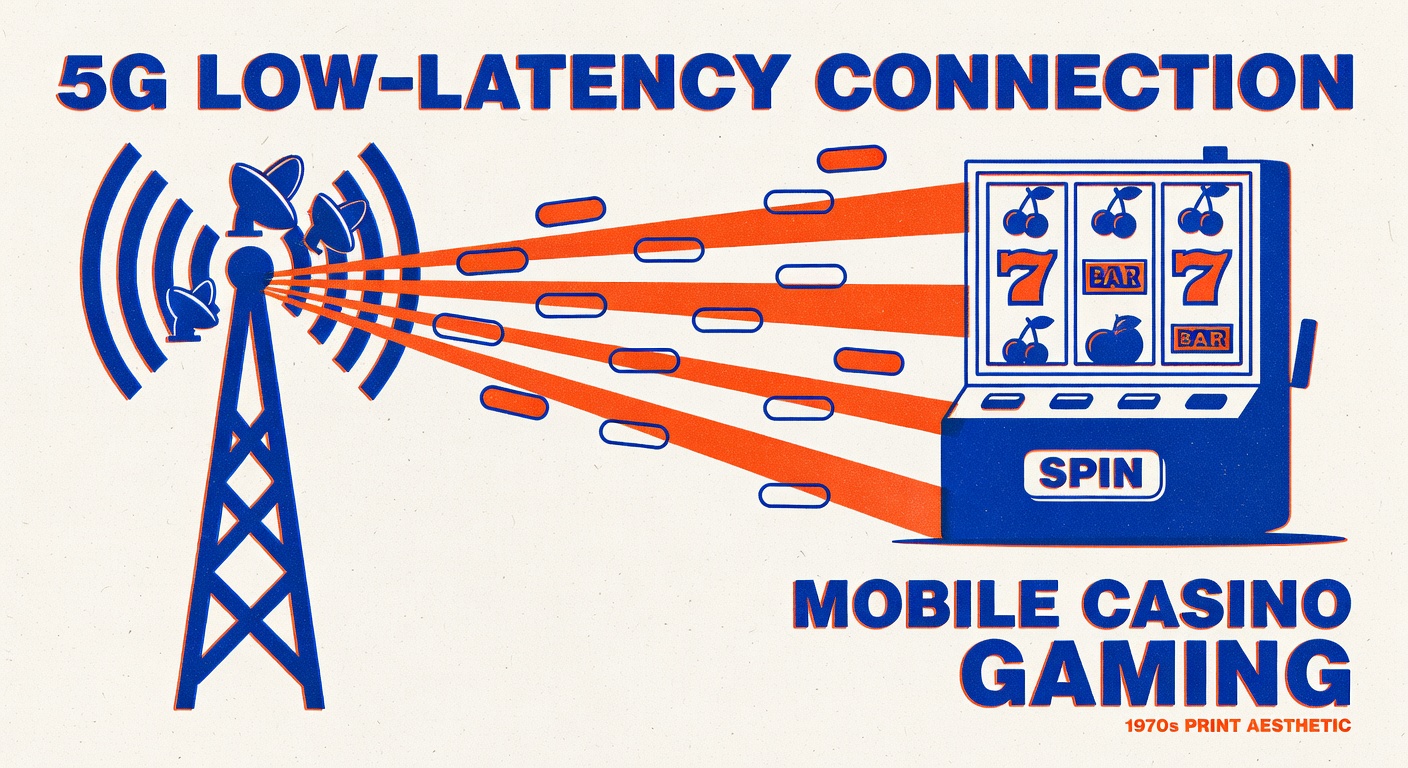
The marketing on 5G mobile casino performance has outpaced the measurable reality. Most of the claims people make about it do not survive a decent network test.
This is not a case against 5G. 5G is a real technology with real performance improvements over prior mobile standards. It is a case against the specific overstatements being made about its effect on casino gaming, and the way those overstatements obscure the bottlenecks that actually matter to a player's experience.
Claim: 5G makes slots spin faster.
Reality. A slot spin is not bottlenecked by network speed in the way people often assume. The random outcome for each spin is generated by the server, usually in under ten milliseconds, sent back to the client as a small packet, and then animated locally on the player's device. The total round trip on a 4G connection is typically in the 50 to 120 millisecond range. On 5G, it drops to the 10 to 30 millisecond range. That is a real improvement. It is not an improvement that most players perceive, because the animation itself takes two to four seconds, entirely determined by the game client, and the network time is a small fraction of that total. A slot spins at the speed the game designer decided it would spin.
Claim: 5G eliminates buffering during live dealer streams.
Reality. Live dealer games stream video from the studio to the player over HTTPS using a protocol stack that is largely indifferent to whether the underlying carrier is 4G or 5G, provided the available bandwidth exceeds the stream's bitrate. A typical live dealer stream runs between 1 and 3 megabits per second. 4G networks, under good signal conditions, routinely deliver 20 to 40 megabits per second. 5G delivers more, but the ceiling in 4G was already well above what the streams require. The buffering that players actually experience tends to come from handoffs between cell towers, signal strength drops, and studio-side encoding issues, none of which 5G meaningfully addresses. In dense urban environments on a strong signal, 5G is more reliable. In a suburban living room with full bars on 4G, the stream quality is the stream quality.
Claim: 5G reduces latency enough to matter in live poker.
Reality. Online live poker has decision windows of fifteen to thirty seconds per action. A network latency difference of 40 to 80 milliseconds between 4G and 5G is inside the noise of the decision window. For a player competing in a timed environment, the advantage is imperceptible. The exception is games that require rapid sequential inputs, such as fast-fold poker variants where decision times drop to three to five seconds, and in that context the latency difference becomes marginally more noticeable, but not to the degree that performance rankings shift. Professional online poker players, when asked about network connection, care more about packet loss stability than peak throughput, and stability is primarily a function of signal quality and not generation of standard.
Claim: 5G will enable new types of casino games that were not possible before.
Reality. This claim is repeated in industry marketing material but rarely accompanied by specifics. The games that plausibly benefit from low-latency mobile networks are real-time multiplayer formats with many simultaneous players: live multiplayer blackjack, shared-pot slot tournaments, social casino variants with real-time chat and video. These formats run acceptably on 4G today. A 5G connection allows them to run with slightly fewer hiccups under load, and allows operators to design variants that push closer to the network's limits. No new game category has emerged that could not have been built on 4G. Several new game categories have been marketed as 5G exclusives, but the underlying technology works on any modern mobile connection.
Claim: 5G will eliminate the need for a wifi connection at home.
Reality. For casual casino play, yes, in most markets with good 5G coverage, the home wifi connection is no longer necessary for stable play. For extended sessions of several hours, data caps on mobile plans are more often the binding constraint than bandwidth or latency. A player running five hours of live dealer streaming at 2 megabits per second consumes roughly 4.5 gigabytes. On an unlimited plan this is a non-issue. On a capped plan it is a real expense, and one that the 5G marketing seldom addresses. The household wifi has been replaced, technically, by carrier-grade mobile data, but the economics of doing so for heavy users have not necessarily improved.
Claim: 5G changes the house edge or the game math in any meaningful way.
Reality. It does not. The random number generation, the return to player, the volatility profile, all of these are defined by the game software on the server and are independent of the client's connection quality. A player who believes that a faster connection improves their odds is not observing a change in the game; they are observing the selection effect that comes from playing more rounds per hour, which exposes them to the house edge more frequently. A faster connection that enables more hands per hour actually increases expected loss per hour, all else equal. This is arithmetic, not marketing.
What 5G does actually change
There is a real difference, and it shows up in two places.
- Connection handoffs between cell towers are smoother on 5G networks, reducing the frequency of session disconnects during mobile play. For players who commute and play at the same time, this is a meaningful quality-of-life improvement.
- Download times for new game clients are substantially faster on 5G, which matters when operators push large client updates or when a player installs a new casino app. A 200 megabyte download that took two minutes on 4G finishes in fifteen seconds on 5G. This is a real improvement in the first-time user experience.
Neither of these shows up in the marketing. Both of them are the genuinely useful effects.
The practical read
If your current mobile connection is giving you acceptable play and the operator you use is not telling you that your connection is slow, upgrading specifically to 5G will not measurably change your gaming experience. If you are in an area with poor 4G coverage and 5G has been rolled out with better antenna density, the improvement will be real, but it is an improvement in baseline reliability, not a change in the game itself. The players who benefit most from 5G are those moving through areas with patchy coverage, those who want to reduce reliance on wifi, and those downloading large clients frequently. Everyone else is getting the same house edge, on the same games, in the same amount of real time, whether the carrier's logo on their status bar reads 4G or 5G. The edge is the edge.