
Slot Machines: From Liberty Bell to Modern Megaways
A woman sits down at a machine on a Tuesday afternoon. She has been coming to this casino for forty years. Here is what she has seen change.
Posted by Gamble-24 Slate Desk on . Kick-off to full time in 2 min.
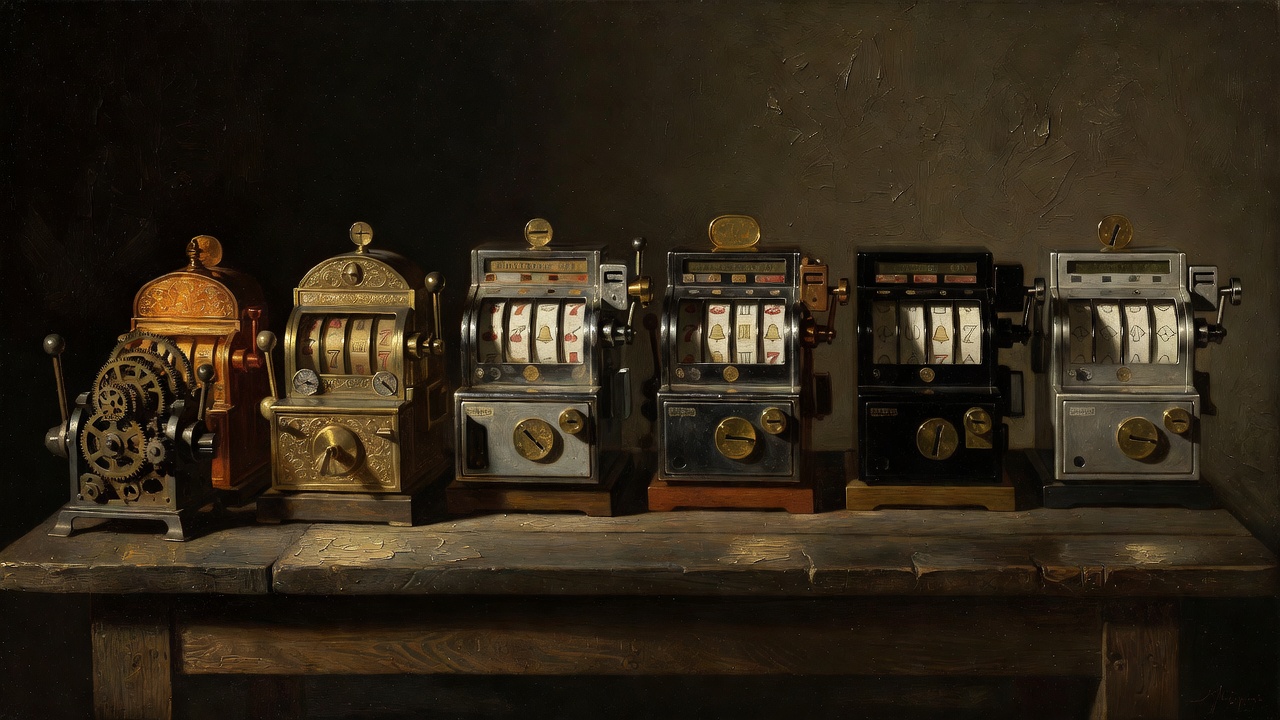
Eleanor started playing slots in 1983 at the Flamingo in Las Vegas. She remembers the machines were mechanical, pure metal and springs and hope. You pulled a handle. The reels spun. The sound they made was unmistakable: a kind of mechanical singing. Three bells meant a jackpot. She never hit three bells.
The first video slot she ever played was in 1994. She thought it was fake. How could a screen be a real game? But the payouts were real. They were always real. She lost the same amount of money whether the reels were spinning metal or dancing pixels.
Eleanor noticed that the machines changed not because they wanted to be better, but because the casinos wanted more. The Liberty Bell machine, invented by Charles Fey in San Francisco in 1899, was simple: three reels, one payline. For nearly a century, that was the standard. Then casinos discovered they could add more paylines. Five lines. Ten lines. Twenty lines. Eventually, a single machine could have 243 ways to win, or 1024, or more. Eleanor understood what this meant: she had more chances to lose on each spin.
What She Learned Without Meaning To
Modern slots use something called Megaways, a system invented by Big Time Gaming. A single spin creates between 324 and 117,649 different winning combinations depending on how many symbols land on the reels. Eleanor, who never learned to code, understood this intuitively. More lines meant the house had more ways to organize your money into its vault.
The other thing that changed was speed. Mechanical machines forced a moment between decision and outcome. You pulled the handle. You waited for the reels to stop. There was a breath in the process. Video machines spin in less than a second now. Eleanor noticed her money disappeared faster. She learned to slow herself down, to sit with her hands folded, to let one full minute pass before pressing the button again. Most people, she observed, pressed faster and faster, as if speed would change the outcome.
Megaways machines also created the illusion of bigger wins. A $100 payout on a Megaways game feels bigger than a $100 payout on a three-reel machine, because the screen shows 50,000 ways you didn't win before showing the few you did. Eleanor found this tiring to watch. She preferred the old machines, where a loss was a loss and a win was simple.
The mathematics stayed the same. Return To Player percentages on old Liberty Bells were around 85-90%. Modern Megaways machines pay out 96-97% on average, which sounds better until you realize you are making decisions 300 times faster. The pace erases the mathematical improvement.
Eleanor is seventy-eight now. She still goes to the Flamingo on Tuesdays. She plays the older machines when they still have them. She watches newer players attack Megaways machines with a kind of hunger she remembers from her own earlier years. She has learned something over four decades that most people don't let themselves see: the machine doesn't change because it gets kinder. It changes because it learned new ways to be kind in appearance only. The money you lose is still lost. The path to that loss is just dressed differently now.
Full time. 2 sections from Gamble-24 Slate Desk.