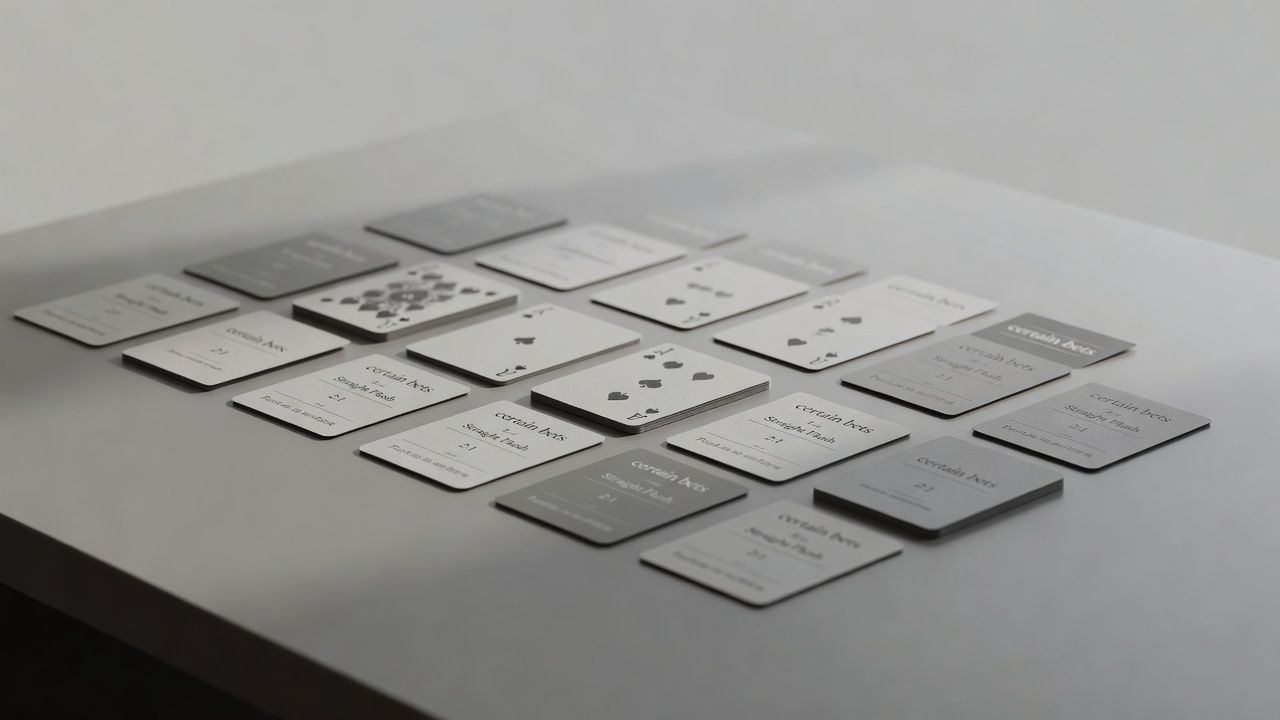
Side bets in table games exist in a narrow space where house edge meets player desperation. The mechanics are straightforward: you wager on a specific outcome outside the main hand, typically at higher payouts and worse odds. Most players never touch them. The ones who do usually lose faster than they would on the base game. But there are exceptions, and they matter if you build a model around the rules themselves.
First, the baseline. A typical blackjack side bet like "Perfect Pairs" pays 25:1 on two identical cards. The house edge ranges from 2.3% to 10% depending on the payout structure and whether you count all suits or just color. For comparison, basic blackjack strategy sits around 0.5% house advantage. You're paying a premium for volatility, pure and simple. The expected loss per dollar wagered is higher. That's not negotiable.
But expected value isn't the only lens. Consider variance. Some side bets compress into single-hand outcomes. The 21+3 bet (combining your two cards and the dealer's up card into a poker hand) has poor long-term value. Yet if you're at a table with a terrible penetration and want to spend the same bankroll over the same number of hands with maximum entertainment per dollar, side bets deliver that. You lose faster, but you know it.
The Mathematical Exceptions
The interesting part is where rule variations flip the math. At certain casinos, specific side bets become playable when the procedural rules are non-standard. Example: the "Dragon Bonus" in Baccarat. Standard Dragon Bonus carries a house edge of around 2.5% on the banker hand. But some casinos offer modified payout tables for certain combinations. If you find a venue where the natural nine combination pays 8:1 instead of 6:1, you've moved into slightly less terrible territory, though still house-favored.
The rarest case is when a side bet is mathematically favorable for a brief window. This happened with certain promotions at Las Vegas tables in the mid-2010s, where a specific side bet became positive EV during promotional periods. These windows close fast. Casinos track them. But they prove the rule: the rules themselves matter more than the payout label.
Second, penetration and removal effects. If you're counting cards at blackjack, your side bet value changes in rare circumstances. With a high count and specific rule configurations, some side bets become less bad. Not good, but less bad. This is academic mostly. Card counting at real casinos is nearly impossible anymore. But it shows how a closed system of rules can be analyzed.
- Track the payout table of any side bet you consider
- Verify against multiple sources (the casino's posted rules differ from third-party analysis sometimes)
- Only play if the variance fits your bankroll psychology
- Remember that "less bad than other bad bets" is not the same as "good"
Third, tournament and promotional contexts. A side bet might be mathematically worse in isolation but strategically correct in a tournament where the leaderboard rewards volatility. If you're down on chips and need to catch up, a side bet's skewed payout distribution might align with your tournament equity. This is different from regular cash play and requires separate analysis.
The real exception is ruleset arbitrage. Some jurisdictions regulate side bet payouts by law. A US state might mandate that "Perfect Pairs" pay exactly 25:1, while a European jurisdiction permits 30:1. If both are available to you and you're traveling, the difference is real. Jurisdictional variance in side bet structure is worth tracking if you play across multiple venues.
Fourth, obscure sub-games. Some casinos offer side bets that are genuinely rare and poorly documented. "Lucky Bonus," "Royal Match," and custom house variants exist. The house edge on a truly obscure side bet is sometimes hidden in plain sight because nobody has done the math. This isn't an opportunity; it's a warning. If a side bet has no published analysis and no third-party verification, you're flying blind. The house knows exactly what they're paying for. You probably don't.
The honest conclusion: side bets are sucker plays designed to extract money from people who want entertainment. They work because table games are social, and side bets feel like participation. Most sessions where players wager on side bets show worse overall results than sessions where they stick to the main game. The exceptions exist only for people who understand the closed system deeply enough to exploit specific rule configurations or promotional windows. If you're reading this thinking a side bet might be your edge, you're probably the target, not the player.
Building a model that accounts for rule variants, penetration, promotional periods, and venue-specific payouts is possible. But it requires that you verify every rule yourself and update your model when casinos change the rules. They do this often. Your edge disappears faster than it appeared.