Perfect Pairs is a side bet in blackjack where you wager that your first two cards will be a pair. That's the entire idea. You bet $5 on pairs, you get dealt 10-10, you win. Mildly useful when it happens. The question is whether it ever actually happens at odds that matter to a sane person.
1. The Numbers
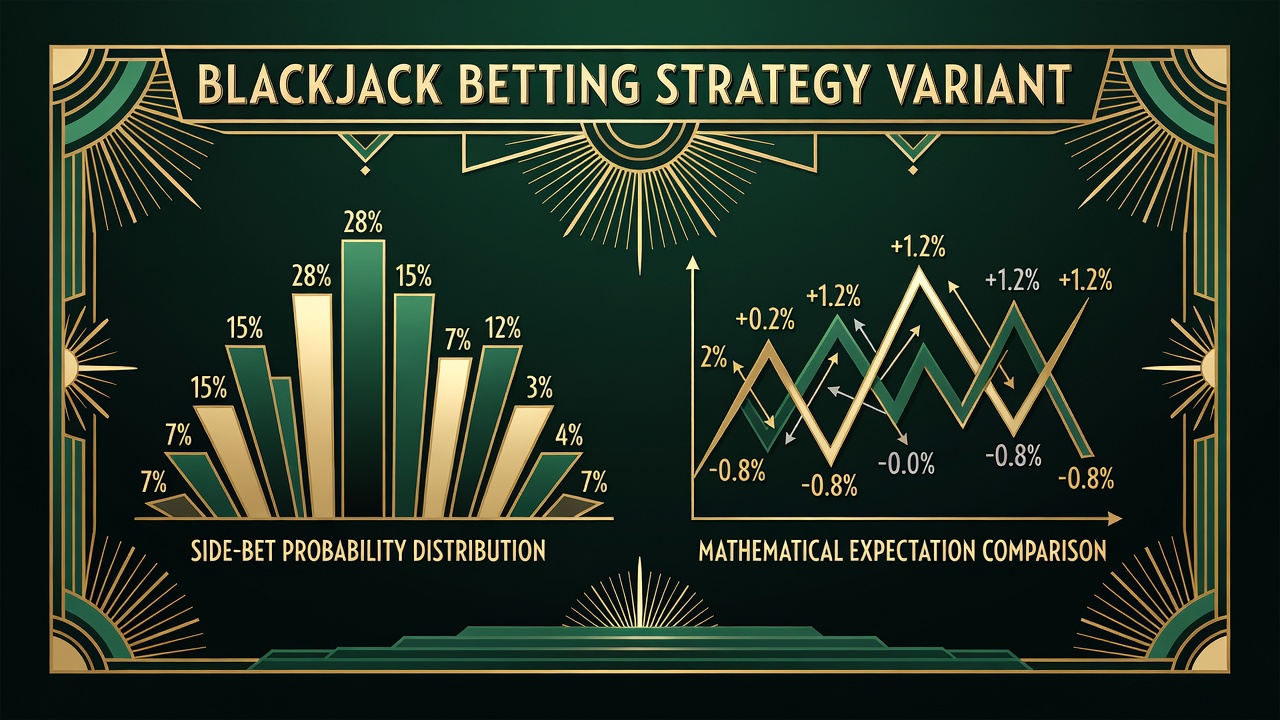
A standard 6-deck shoe contains 24 tens of each type. Your chances of being dealt a pair of any kind are 16 in 312 total possible two-card combinations. That's roughly 5.1 percent.
Split that into:
- Suited pairs: 4.04 percent payout. Real probability: 1.7 percent.
- Unsuited pairs (mixed suits but same rank): 9 to 1 payout. Real probability: 3.4 percent.
- Perfect pairs (same suit, same rank): 25 to 1 payout (varies by casino). Real probability: 0.85 percent.
Instant observation: the house edge on perfect pairs is catastrophic. The $25 payout doesn't compensate for the 0.85 percent frequency with which you actually get them. The math is simple division.
2. Why Players Bite
The payout looks large. Twenty-five times your money feels exciting in the moment. The problem is that feeling excited about a 25-to-1 payout when you're being offered 25-to-1 on a 100-to-1 shot is how casinos buy groceries.
You would need to win the perfect pairs bet roughly every 118 hands to break even on the money you're wagering. Most weekend players don't play 118 hands in a weekend. The expected loss on a $5 perfect pairs bet per hand is somewhere between $0.42 and $0.68, depending on the specific game rules.
3. The Variants
Casinos have had decades to adjust the rules. Some offer different payouts for different numbers of decks. Some use the phrase "premium pair" to mean something different. The Bellagio has six different versions of blackjack running at any given moment, each with its own house edge on side bets. It's basically a science fair project at this point, except the entries are "How can we make players lose money in new configurations."
The worst version is when casinos reduce the payout for perfect pairs from 25-to-1 to 15-to-1 and increase it for unsuited pairs. The net effect is that they've made both bets worse, but the perfect pairs payout looks less inviting, so players shift to the unsuited version, which is still a bad bet but feels like a win for the house because it shifted player behavior.
4. When It Matters
There are exactly two scenarios where the perfect pairs side bet makes sense. Both are theoretical. First: if you are a skilled card counter and can identify when the shoe is running heavily to pairs for reasons related to discard composition. This is not the experience of 99.98 percent of players. Second: if you enjoy the variance and you're okay losing that specific $5 as the cost of having a more exciting evening. This is called having fun with money you can afford to lose, and it's honest.
5. The Math Doesn't Budge
The perfect pairs bet is mathematically the same structure as every other exotic side bet in table games. You're paying premium prices for long-shot outcomes. The expected value is negative for the player. This doesn't change based on how good your intuition is, how lucky you feel, or whether you're on a winning session. The probabilities are stable across the shoe.
If you want to gamble on your first two cards, gamble on the actual hand. At least then you're getting something back from your bankroll besides the privilege of learning about probability at a rate of $20 per concept.