Online poker emerged as a commercial product in 1998. PartyPoker began accepting American players in 2001. At that moment, no full regulatory framework existed for the activity. What followed was a global regulatory divergence that persists today.
2001-2006: The American Boom and Absence of Regulation
2001-2006: The American Boom and Absence of Regulation. Online poker in America operated in a legal gray zone. No federal law explicitly prohibited it. State laws were unclear or silent. Operators licensed themselves in jurisdictions (mostly the Caribbean) that offered quick approval, minimal oversight, and a business-friendly regulatory environment. The result was explosive growth: PokerStars, Full Tilt Poker, and Absolute Poker grew to serve American players almost unopposed. Revenue in 2005 exceeded 2.5 billion dollars. None of it was taxed or regulated by American authorities.
2006-2011: Legal Crystallization and Federal Action. The Unlawful Internet Gambling Enforcement Act (UIGEA) was passed on October 13, 2006, as a rider to the Port Security and Illegal Gambling Enforcement Act. It did not ban online poker; it banned banks from processing payments to online gambling operators. This created an immediate implementation crisis. Payment processors that served operators faced federal charges if they continued processing American transactions. By April 2011, the Department of Justice indicted the founders of PokerStars, Full Tilt, and Absolute Poker on charges of wire fraud, money laundering, and UIGEA violations. Black Friday (April 15, 2011) followed: the government seized the domains of all three operators and froze their American assets.
2011-2015: The European Model Solidifies. While America was criminalizing poker, European jurisdictions were legalizing and regulating it. The Malta Gaming Authority, established in 2001, began issuing licenses to operators willing to submit to financial audits and player-protection standards. The UK Gambling Commission, created in 2007, took a different regulatory approach: operators had to apply for approval, but the standards were rigorous and the oversight was real. By 2011, the regulated European online poker market was worth approximately 600 million dollars annually across all jurisdictions. Operators were paying taxes, maintaining capital reserves, and submitting to independent audits.
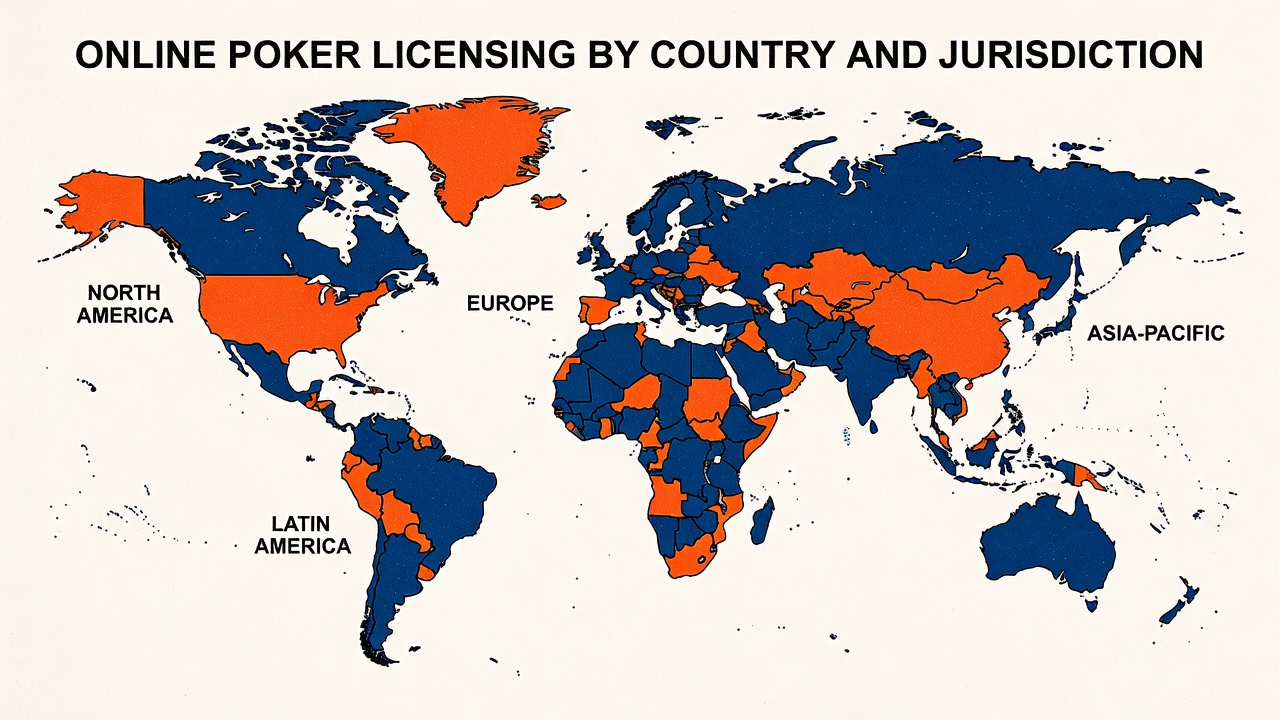
2015-Present: American Fragmented Re-Entry and Global Consolidation. Nevada, New Jersey, and Delaware began licensing online poker in 2013, 2013, and 2012 respectively. Pennsylvania followed in 2019. The American regulated market grew slowly, hamstrung by state-level restrictions and limited interstate play. Meanwhile, the global regulated market (Europe, South America, Asia) consolidated around a small number of large operators (GGPoker, PartyPoker, BetVictor) licensed primarily in Malta or the UK. The offshore market persisted in jurisdictions (Russia, Costa Rica, soft-touch Asian licenses) where regulation was minimal. By 2023, the legal status was clear: operators could either be licensed in a regulated jurisdiction, pay taxes, maintain reserves, and accept player-protection requirements; or they could operate offshore and accept the risk of government seizure, account freezes, and criminal charges.
The pattern across jurisdictions is consistent: prohibition fails (America learned this), unregulated private business fails (operators disappear with player money), and light regulation has produced the most stable markets (Malta, Gibraltar, UK). The operators that survived and thrived are the ones that submitted to regulation and accepted the cost of compliance as a long-term business expense.
Three jurisdictions exemplify the outcomes. America, having chosen prohibition in 2006, spent fifteen years rebuilding a regulated market state by state, achieving market fragmentation and missing the global consolidation window. Malta, having chosen light regulation with high standards, became the global hub for licensed operators and accumulated approximately 300 million dollars in annual tax revenue from gaming operators. Costa Rica and Curaçao chose minimal regulation, maximized operator freedom, and accumulated a reputation for insolvency, player fraud, and eventual seizures by American and European authorities. The jurisdiction a player chooses to play in determines whether their money is reasonably safe or catastrophically at risk.