The Mythology
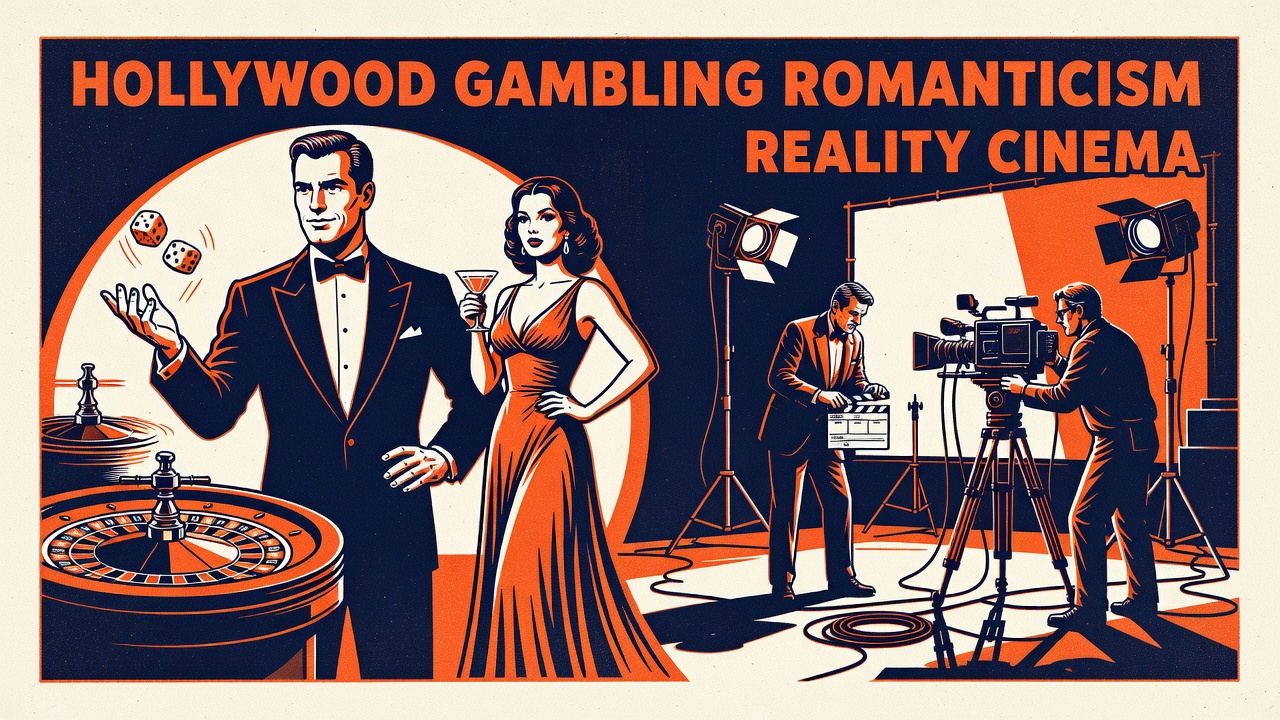
In 1950s Hollywood, gambling was elegant. A man in a suit. A woman in a dress. A roulette wheel. Champagne. The implication was always that gambling was a gentleman's game, a test of character.
The actual gambling was incidental to the plot. The real story was: Can this person maintain composure under pressure? The gambling was a metaphor.
The Depiction
Classic Hollywood never showed problem gamblers. It showed men who gambled for sport. The money was not important. What mattered was the game itself.
In real life, gambling destroys families. In classic Hollywood, gambling tested a man's virtue and he either passed or failed. The money was not real. It was symbolic.
Lady Luck
Lady Luck is a persistent character in classic Hollywood gambling films. She is a personified force that rewards the worthy and punishes the undeserving.
The idea is absurd. Luck is not a character. Luck is variance. But the personification served a purpose. It made gambling feel less mechanical. It made the outcomes feel less predetermined.
If luck is a lady and you can charm her, then you have agency. You have a chance. Reality is: the probability is fixed, you do not have agency, and charm does not matter.
The Real-World Disconnect
Classic Hollywood depicted gambling as a domain where the morally superior person wins. The con artist loses. The honest man wins. The cheat gets caught.
In reality, morality is irrelevant. The person with better probability wins. The con artist with better information wins. The honest man with worse odds loses.
Hollywood created a mythology where the moral arc bends toward justice. In gambling, the arc bends toward negative expected value.
The Game as Narrative
In classic films, the gambling game is a narrative device. A poker game between the hero and the villain. The game determines who lives. Who dies. Who gets the girl.
It is not a game. It is a story. The probability is whatever the screenwriter decides. In real gambling, the probability is fixed by mathematics.
The Later Deconstruction
By the 1990s, filmmakers understood that the classic mythology was bankrupt. House of Games and Rounders and Casino moved away from the idea that gambling is romantic.
They showed gambling as it is: addictive, destructive, and mathematically against you. The games were still interesting. But they were not noble.
Houston was not in House of Games to test his virtue. He was there to cheat and manipulate. The movie did not justify his gambling. It showed the psychology behind it.
The Persistent Myth
Despite the deconstruction, the classic Hollywood myth persists. People still believe that gambling is a game of character. That the best player wins.
It is not. The best card gets dealt. The wheel lands where it lands. Character is irrelevant.
But the myth is profitable. Casinos benefit from people believing that luck rewards the worthy. If people believed that gambling is mathematical and always favours the house, fewer would play.
The Modern Irony
Modern films have stopped glamorizing gambling. But gambling itself has become more glamorous. Online casinos market to celebrities. Poker is broadcast on television. Esports betting is promoted to teenagers.
The depictions have become more honest. But the audience has become more naive.
Hollywood was wrong about the philosophy of gambling. But it was right about one thing: the game is always more interesting than the math.