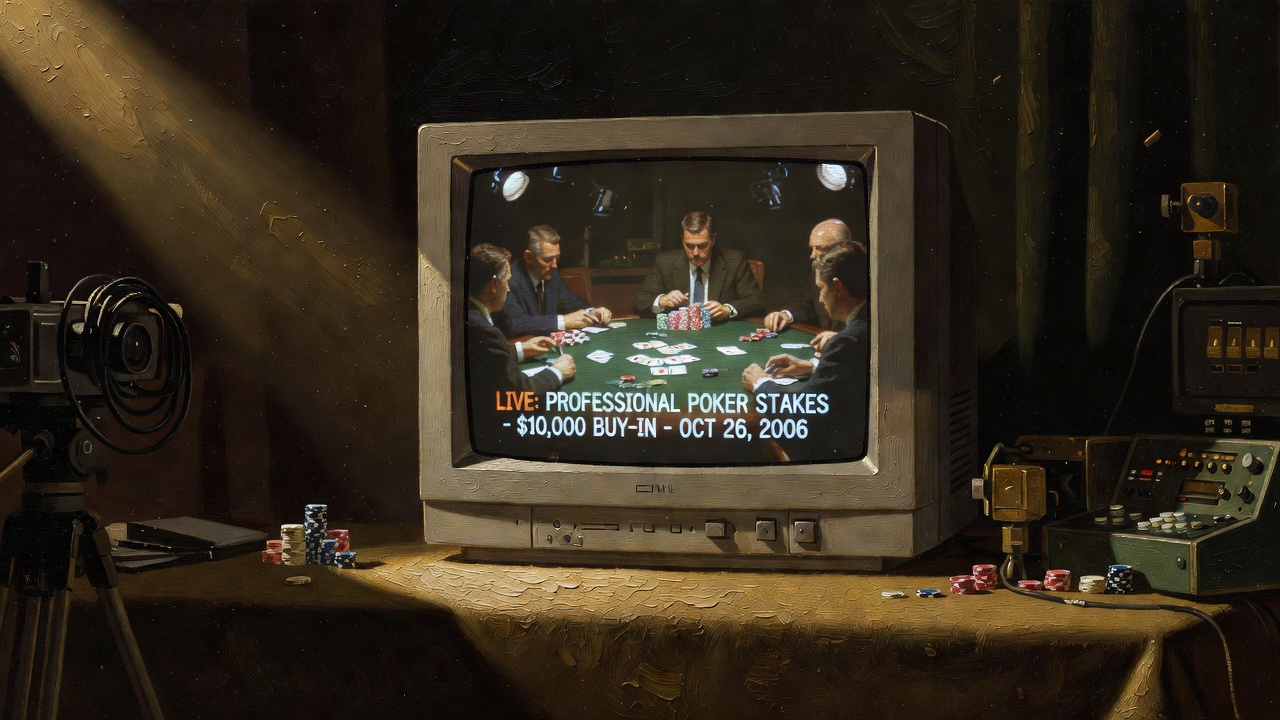
The production value was minimal. Four cameras, a dealer, a 10,000 dollar buy-in minimum, and a group of players who had decided to let themselves be filmed while playing for stakes that could destroy a person in five minutes.
I spent three years embedded in underground poker rooms in the Northeast
I spent three years embedded in underground poker rooms in the Northeast. I know how players talk when the cameras are not present, when the bravado can drop and the fear becomes visible. High Stakes Poker captured something that most gambling television sanitizes away: the actual weight of money being risked by people who know exactly how much it costs.
The show opened with a theme that sounded like a heist film. That was accurate. The premise was simple: professional players, known quantities, sitting at a table with rotating high-roller guests. The game was Texas Hold'em, no limit, nine-handed. The minimum buy-in was 10,000 dollars. A player could lose 300,000 dollars in a single session.
The ritual of the room was preserved with accuracy. The dealer spoke in the dealer voice, neutral and efficient. The brush (the casino employee who manages the games) stood watch. The cashier was present. The game proceeded according to the protocols that real players understand: position, action, rotation. This was not theater; it was documentation.
What made it compelling was the table composition. Doyle Brunson was often present, a legend from a previous era. Barry Greenstein was there, playing tight and winning consistently. Vanessa Selbst appeared occasionally, the only woman in a male-dominated game, playing with a precision that the men acknowledged with silence (respect for another professional). The rotating guests were often wealthy amateurs: a hedge fund manager, an internet entrepreneur, someone who had come into money and wanted to sit with professionals.
The amateurs were the point of failure for most viewers. The professionals were predictable (tight, disciplined, playing well). The amateurs were volatile (playing loose, making aggressive calls with weak hands, losing large amounts without understanding why). The tension came from watching someone with a finite bankroll test themselves against professionals. The amateurs knew they were overmatched. Sometimes they had the discipline to leave when down 50,000 dollars. Often they did not.
The show's impact was not on strategy. Serious poker players had already moved past the material shown on High Stakes Poker. The impact was cultural. It made professional poker visible to people who thought of it as a vice or a con. They saw disciplined people making mathematical decisions. They saw bets justified by position and pot odds and hand history. The show did not glamorize winning; it showed the grind of small advantages compounded over thousands of hands.
The implicit agreement among all the players was that the cameras created no illusion. This was how they actually played. No editing, no dramatic music cues, no narrator explaining what was happening. The production got out of the way and let the game explain itself.
The show ended in 2009, after six seasons. By then, Black Friday was visible on the horizon. Online poker was about to be prosecuted. The era of professional poker as an accessible American profession was about to contract. High Stakes Poker had documented the apex of one subculture right before that subculture was diminished by regulation and legal pressure.