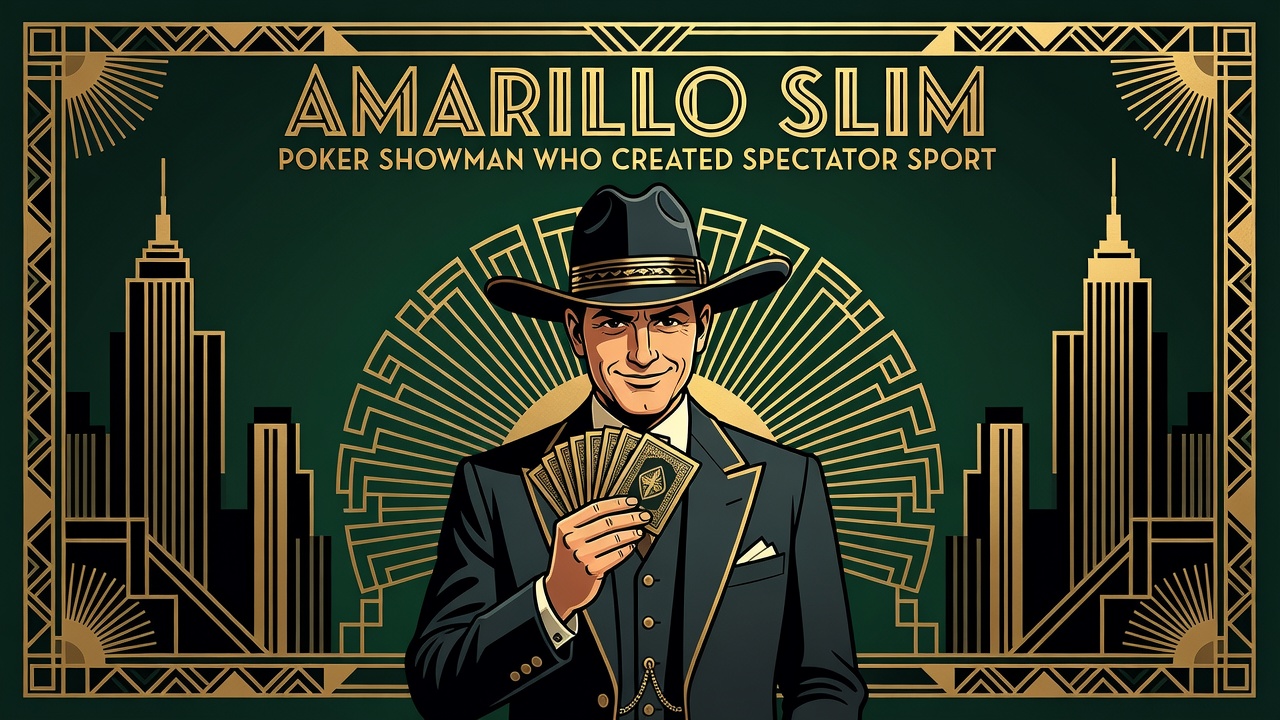
The first time Amarillo Slim entered a high-stakes poker game, he did not sit down to play cards. He sat down to perform. This was 1962, in a Dallas room. Slim was thirty-four years old, already a veteran of a thousand smaller games across Texas and Oklahoma. He understood something most poker players do not: the table is not a place of commerce. It is a theater, and the most profitable player is the one who understands stagecraft.
Slim's real name was Thomas Preston. He'd picked up "Amarillo" from the Texas panhandle town where he'd accumulated his first serious bankroll playing golf hustles and poker games in the 1950s. The nickname stuck because it sounded like a Western character, and Slim understood the power of branding before the word existed in this context.
The Ritual
When Slim played, he arrived in expensive clothes. Not ostentatious; careful. A tailored shirt, a Stetson if the room allowed it, cowboy boots polished to a shine. He carried cash, a lot of it, in a money clip. When he bought chips, he did it slowly, making sure everyone at the table saw the transaction. Money, he understood, was a tool for creating psychology.
He talked. Most serious players play close to the vest. Slim narrated. He told stories about other games, other towns, other players. He made jokes about the people at the table, never cruel, always with a wink. He let people win small pots against him. He positioned himself as the guy who'd seen it all, who was here for entertainment as much as money, who might lose a hand to any player at this table because, well, poker is a game of chance.
This was misdirection on a level the rooms had rarely seen. While Slim was talking, he was watching. While he was watching, he was calculating. The performance was the point. The cards were secondary.
The Games
Slim's first major score came in a game in Dallas in the mid-1960s. The stakes were heavy. He played against wealthy oil men and professional gamblers. The game lasted three days. Slim left with seventy thousand dollars, which was significant money in 1964. He announced it to everyone at the room. Not bragging; simple fact. He had to establish that Amarillo Slim won big pots.
What distinguished Slim from other high-stakes players was his willingness to be known. Most professional poker players worked in shadow. Slim worked in light. He became a public figure, someone whose presence at a game was itself an attraction. Casinos invited him to sit at games because his name drew other players. People wanted to play against Slim, to test themselves, to see if they could beat the cowboy.
By the early 1970s, Slim had established himself in Las Vegas. He played in the high-limit rooms at the Dunes, the Sands, the Golden Nugget. He played in private games at houses in the hills. He played against business magnates, professional athletes, other professional poker players. He was no longer just playing poker. He was operating a business that centered on his presence and his reputation.
The Transformation
Slim understood before anyone else that poker could be mass entertainment. In 1973, he entered the first World Series of Poker Main Event, held at Binion's Horseshoe. He finished seventh. This was important not because of the finish but because he showed up. He was photographed. He was interviewed. He had moved poker from a back-room operation into a place where cameras could find him.
Later, in 1974, he returned to the WSOP. He played in multiple tournaments. He made a final table. He positioned himself as a bridge between the old-school underground poker world and the emerging legitimate gambling industry.
When television discovered poker in the late 1970s and 1980s, Slim was one of the first serious players it sought. He understood television. He understood that poker, on television, was not about cards. It was about personalities. It was about conflict, edge, showmanship. Slim delivered all three.
The Legacy
Amarillo Slim died in 2012 at the age of eighty-three. His autobiography, "Amarillo Slim in a World Full of Fat People," was published in 1984. In it, he claimed to have won over twenty million dollars playing poker, golf, and other games. The number is probably inflated, but that's beside the point. The point is the self-mythology.
Slim understood something that most players never do: the game and the player are not separate. The game is defined by who sits in the seat. By making himself visible, famous, eccentric, Slim changed the game itself. He made poker glamorous. He made it visible. He made it a sport worth watching.
The cards are random, but the player is not. Everything else flows from that observation.