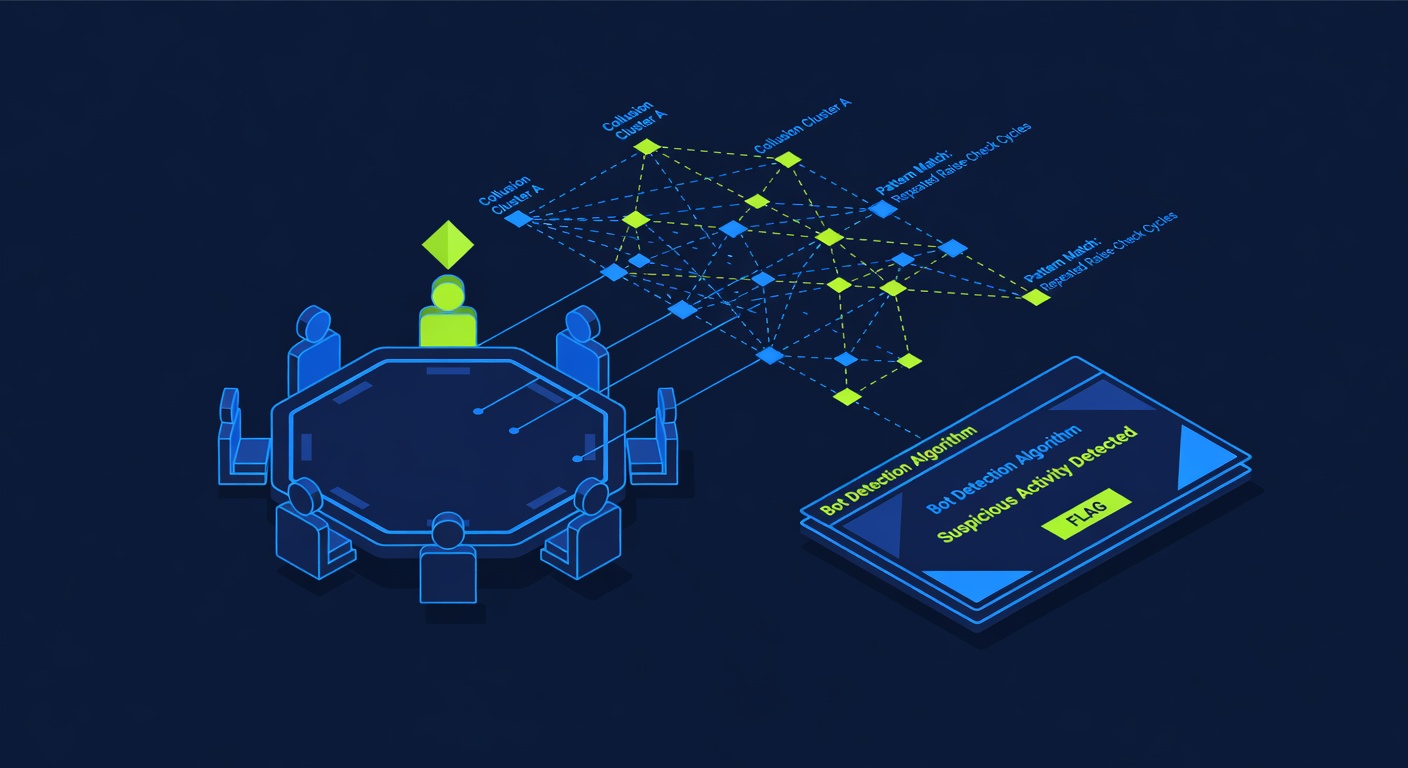
A poker room has statistical tools. They track every hand. They look for: (1) unusual winrates, (2) unusual play patterns, (3) unusual account characteristics, (4) clustering of accounts. Bots fail the second test. Collusion rings fail the fourth.
A bot will play the exact same strategy regardless of opponent or situation. The fold rate to raises will be 42.3 percent always. A human folds 42.3 percent sometimes, 50 percent other times, 35 percent against specific opponents. The variance is gone in a bot. The poker room flags the consistency.
Collusion is players working together. They share hole cards remotely. They coordinate bet sizing. They fold to their friends and aggress against strangers. The detection: account clustering. Five accounts registered from the same IP, same payment method, same geolocation. They all play the same tables. They never raise against each other, always fold. The correlation is obvious once you plot it.
The False Positives
Regular players sometimes get flagged for unusual patterns. A player who only plays certain games (maybe they're a sniper waiting for soft tables) might show clustering. The poker room has to distinguish: is this a specialist playing their game? Or a bot that only knows one strategy?
The tool is imperfect. Some genuine specialists get falsely flagged. Some sophisticated bots pass detection. But the majority of bots and collusion rings are caught because the patterns are distinctive. A bot is reproducible. Reproducibility shows up in statistics.
The Winrate Red Flag
An elite human poker player might have a 3 percent winrate over 10,000 hands. A bot with good strategy might have a 4 percent winrate. But the variance is different. A human 3 percent player will have swings: month one 6 percent, month two 0 percent, month three 3 percent. A bot 4 percent player will have: month one 4.1 percent, month two 3.9 percent, month three 4.0 percent. The consistency is suspicious.
The poker room runs a calculation: what is the probability this account's variance distribution matches a human player? If the probability is less than 5 percent, the account is flagged for review. A human analyst looks. They see the pattern. They check the GTO solver against the bot's plays. If the bot is always playing GTO, it's a bot. Humans never play perfect GTO.
Collusion Clustering
Five accounts all register from the same IP address. They all play 6-max tables (smaller tables, fewer players, higher variance). They all play at 2am EST (off-hours, fewer witnesses). They all sit in specific positions relative to each other (accounts A and B sit next to each other, C is opposite, etc.). They fold to each other 95 percent of the time, raise against strangers 45 percent of the time.
The correlation of variables is: if account A raises, account B folds 98 percent of the time (should be 50%). The poker room flags this. They review the hand history. They see: A raises with Queen-Jack offsuit. B folds. Later, hand history (visible to collusion) shows B had Ace-King. B folded to account A's raise when B had the best hand. This is collusion.
The Enforcement
Bots get banned permanently. Accounts closed. Winnings forfeit (sometimes). The bot operator loses. Collusion participants get banned. Both the accounts doing the colluding and (sometimes) related accounts. Poker rooms share blacklists. Banned on one site, you're tagged at others.
The standard of proof is statistical, not legal. A poker room doesn't need to prove beyond reasonable doubt. They need to prove the odds of the behavior being random are less than 1 in 1000. That's sufficient for a ban.
Why This Matters
Online poker integrity depends on bots and collusion being detected and punished. If they're not, casual players leave (they lose to cheaters). Sharp players remain (they beat cheaters). The ecosystem becomes tainted.
Modern poker rooms are aggressive about detection because it's existential. A poker room without bot/collusion detection dies. The ones that detect actively and ban frequently survive.