The poker room is different from home games. Everything operates by rule. Verbally declaring your hand doesn't bind you. Only action at the table or clear hand exposure counts. The dealer is not your enemy. The room is not rigged. The infrastructure is designed to move money from players to the house, and from bad players to good ones.
Getting Seated
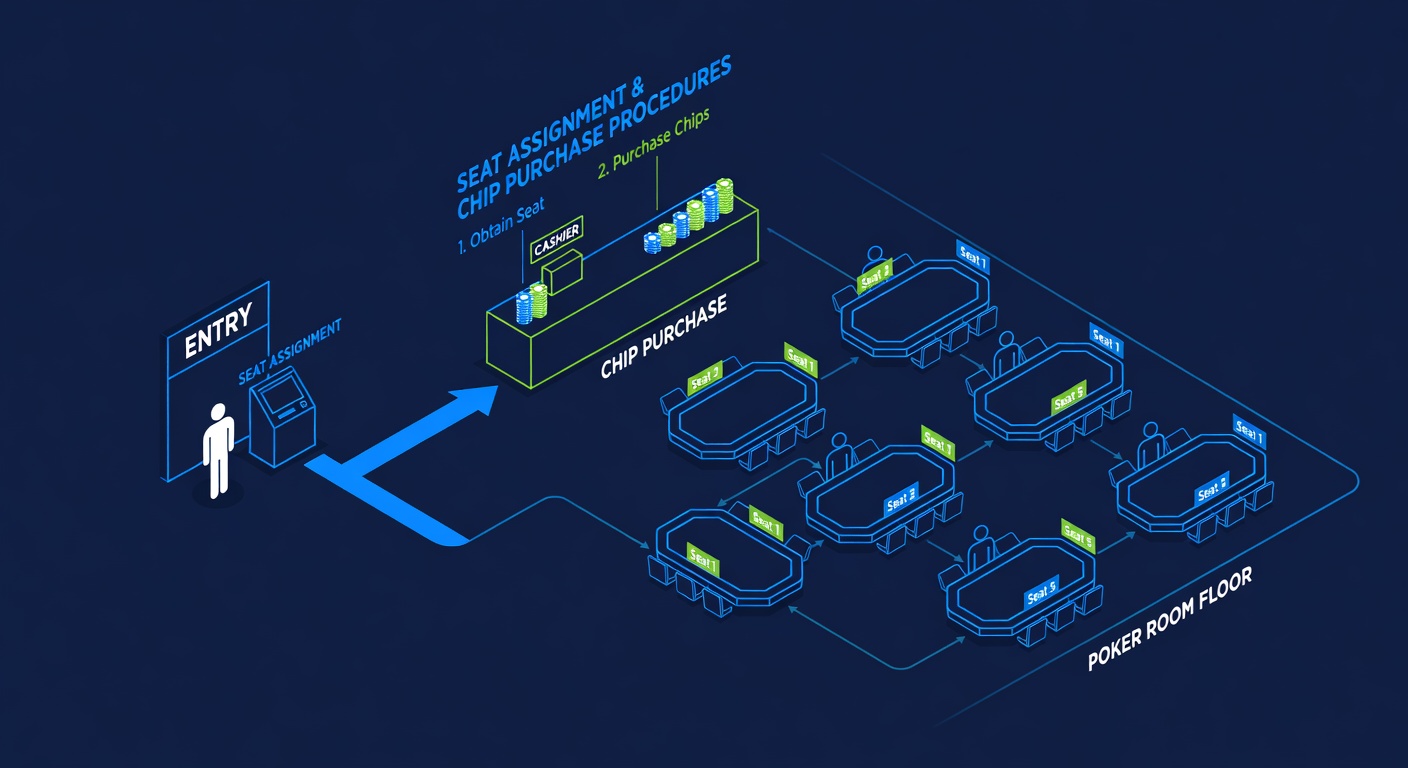
You walk in. You find the desk. You give your name and bankroll preference (1-2 no-limit, 2-5, whatever). They write you down. You wait. Poker rooms run lists. When a game opens a seat, they call the name. You respond. You're in.
Draft pick strategy: choose a game with weak players (a must), then choose position (later position is better, you play fewer hands), then choose depth of stacks (deeper is better because you can win more, but it means higher variance). Your first time, you're likely the weakest player. Accept this. Play tight. Fold most hands. Let the game teach you.
House Rules You Don't Know
The room enforces rules home games don't have. You can't announce action verbally; you have to do it. A verbal check doesn't count. You have to physically check. This prevents angle shooting. A player says "all-in" but then retracts it. At home, gentlemen's agreement. In a casino, if you didn't put chips in, it didn't happen.
All-in rules: you can only win up to the amount you've put in the pot. If you go all-in for 80 dollars and face a 100-dollar bet, you can only win 80 dollars from each opponent. Any amount over 80 goes to a side pot. This prevents a short-stacked player from hitting a miracle hand and then walking with all the chips.
Collusion and angle shooting are monitored by floor staff and camera. You cannot play soft with your friends. You cannot slow-roll (reveal your hand slowly to torture your opponent). These create friction with the room and other players.
Tipping and Fees
Poke rooms take a rake: typically 5 percent of each pot up to 5 dollars per hand, or a flat hourly fee (5 to 10 dollars). You pay this from your stack directly. It's not optional.
You also tip the dealers. Standard is 1 dollar per pot won (if the pot is small) or 2 to 5 dollars if the pot is large. You're not required to tip. You're incentivized to by the dealer's body language (they'll remember you next time you're at their table).
Food costs extra. Coffee costs extra. The room subsidizes nothing. Budget 15 to 25 dollars for the experience before you play a hand.
The Actual Play
Your first hand is button. You fold. Your second hand is small blind. You fold. You're seeing 30 to 40 percent of flops and folding immediately if you miss. This is correct. Tight is right when you're learning.
When you do play, play the obvious spots. Top pair, top kicker is a value bet. Bottom pair is a fold. Three of a kind is a monster. Don't semi-bluff on your first day. Don't balance your range. Just play straightforward poker. The room will exploit you if you get fancy, and it'll exploit you more if you get fancy badly.
The Mental Game
You will lose money. This is almost guaranteed. The house takes rake. You're new. The other players have read you for weakness. You will make fundamental mistakes (calling too much, playing too many hands, giving up on the flop when you should keep pressure). Accept this upfront.
Your goal is not to win. It's to last 4 to 6 hours without going completely broke. Use that time to observe. Who's tight, who's loose, who's aggressive, who's passive. Poker is a game of edges. The first edge is information. Gathering information is more valuable than winning your first session.
The Unwritten Rules
Don't slow-roll. Don't take forever on a decision (you get maybe 60 seconds per action). Don't complain about bad beats. Don't criticize other players' decisions loudly (the floor will ask you to leave). Don't drink excessively. Don't use your phone.
Be respectful to dealers and other players. Say thank you when they compliment a good play. Take a loss without tilting. Tilt is visible and players exploit it.
The First Session Reality
You'll play a 1-2 game. You'll lose 60 to 150 dollars depending on variance. You'll make mistakes you only see three hours later when you're processing hands. You'll wonder why the 50-year-old across the table keeps folding. You'll think everyone at the table is better than they are.
The hardest part isn't the rules. It's the speed and the stakes. Home games move slowly. Casino games move fast. Home games are for fun. Casino games are for money. The psychological adjustment takes 5 to 10 sessions. Until then, you're outmatched just by the environment.