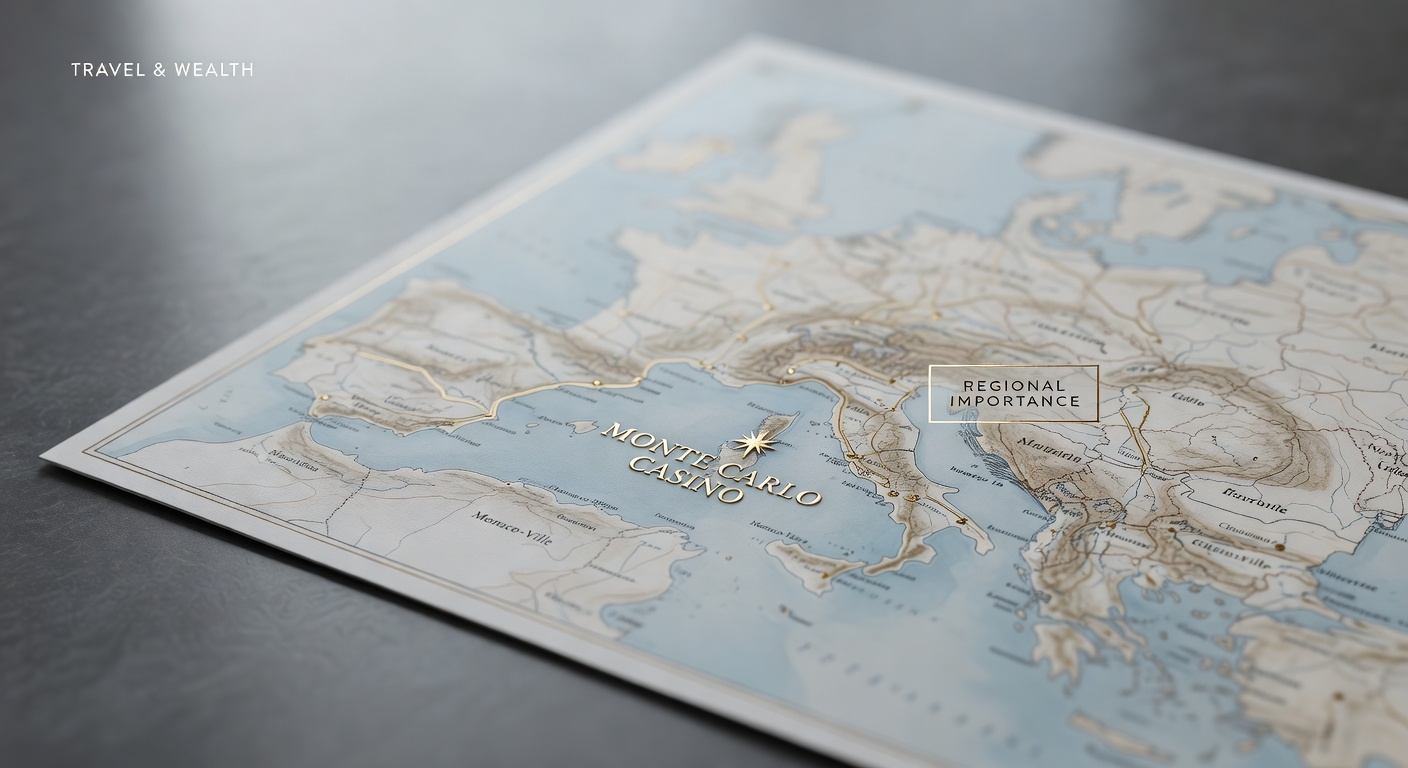
Monaco is 2.02 square kilometres, smaller than many urban neighbourhoods, and in 2023 it recorded a per-capita gross domestic product of approximately 234,000 US dollars, one of the highest on record for any sovereign state. The casino at Monte Carlo is not the entire reason for that figure, but it is the entire reason the figure begins in the nineteenth century rather than the twenty-first.
This is a concept-first piece. The concept is that a small state faced with imminent insolvency used a legal casino monopoly to generate foreign exchange earnings from a class of visitors who brought their money with them, and in doing so invented a model of destination gambling that every subsequent casino jurisdiction has either copied or reacted against.
The numbers that matter
Monaco's population in 1850 was approximately 1,200 people. The principality's revenue came mostly from duties on olive oil and lemons grown on the hillsides of Menton and Roquebrune, which were then part of Monegasque territory. When Menton and Roquebrune seceded in 1848 and were absorbed by the Kingdom of Sardinia (and later France) in 1861, Monaco lost roughly 95 percent of its land area and a similar proportion of its agricultural revenue. The ruling Grimaldi family, specifically Prince Charles III, was facing a state that could not pay its administrators.
The solution, proposed in 1854 by the Princess Caroline, was a legal gambling concession. France and neighbouring Italian states had either banned casino gambling or restricted it to spa towns. Monaco had no such restriction, and its independent sovereignty (confirmed in 1861 by treaty with France) gave it legal authority to license a casino without competing jurisdictions able to object.
The first concession opened in 1856. It failed almost immediately. It was poorly sited, poorly managed, and accessible only by a mountain road that took hours to traverse from Nice. Visitors did not arrive in numbers sufficient to cover the operator's costs.
The concession changed hands three times before it was acquired in 1863 by Francois Blanc, who had previously operated the casino at Bad Homburg in the German Confederation. Blanc understood the destination gambling model in a way his predecessors had not.
What Blanc did
Blanc made three operational changes, all documented in the Société des Bains de Mer archives, which remain the official record of the casino's early decades.
First, he relocated the casino to the plateau of Spélugues, which he renamed Monte Carlo in honour of Prince Charles III (the name appeared on maps for the first time in 1866). The new location commanded a view of the Mediterranean and was connected to the harbour and to the rail network by a purpose-built road.
Second, he financed and lobbied for the extension of the rail line from Nice to Monaco, which opened in 1868. Travel time from Nice dropped from roughly five hours by coach to under two hours by train. Visitor numbers tripled within eighteen months of the rail opening, according to SBM visitor logs published in the 1870s.
Third, he bundled the casino with a hotel (the Hôtel de Paris, opened 1864), an opera house (the Salle Garnier, opened 1879, designed by the same architect as the Paris Opera), and a resort infrastructure aimed specifically at wealthy foreign visitors. The casino was not the destination on its own. The casino was the monetisation layer on top of a destination.
The revenue figures
By 1870, the casino's gross gaming revenue was sufficient for Prince Charles III to abolish direct taxation on Monegasque citizens. That policy, instituted by Ordinance of February 1869, has remained substantially in place to the present day. Monaco has no personal income tax on residents (with narrow exceptions for French nationals under a 1963 treaty), and the state's budget is funded largely by VAT, corporate tax, and the casino concession fee.
By 1880, the casino was reportedly generating revenues equivalent to roughly 20 million francs annually in that era's currency. Converting historical franc figures to modern equivalents is imprecise, but economic historians estimate this corresponds to something in the order of 100 to 150 million euros in 2020 purchasing power. Much of this revenue flowed back to the state through the SBM concession, which paid a share of gross revenues directly to the Monegasque treasury.
The casino's share of national revenue peaked around 1900 at approximately 95 percent. It has declined steadily since. Current estimates place casino-sourced revenue at roughly 5 percent of state revenue, with banking, luxury real estate, shipping registry, and tourism broadly defined making up the remainder.
Why the model was durable
The Monte Carlo model worked for a specific reason. The principality's legal independence from France and Italy meant it could offer a product those countries' residents could not obtain at home. The rail and road infrastructure meant those residents could actually reach it. The bundle of luxury services meant the product was priced not against other casinos but against other luxury experiences, where the gambling was one component among several.
The competitive moat closed partially in the 1930s when France legalised casino gambling in designated spa towns, including Nice, Cannes, and Deauville. Monaco responded by moving upmarket, investing in rarity of experience rather than volume. The Salle Garnier and the Hôtel de Paris became the brand, not the tables.
The moat closed further in the post-1990 period as jurisdictions including Macau, Las Vegas, Singapore, and various online operators began competing for the same international gaming wallet. Monaco's response was to reduce its reliance on gaming revenue, which is why the current 5 percent figure is lower than the 95 percent of 1900.
What Monte Carlo invented
A concrete inventory of the model:
- A legal monopoly granted by a sovereign state to a private concessionaire in exchange for a share of revenue.
- Co-location of the casino with luxury accommodation, dining, entertainment, and transportation infrastructure.
- Targeting of visitors from jurisdictions where gambling is restricted, drawing on the differential in legal availability.
- Reinvestment of gaming revenue into state infrastructure, reducing or eliminating direct taxation of residents and creating a reinforcing cycle of investment in visitor experience.
- Brand construction centred on prestige and exclusivity rather than volume.
Every major casino jurisdiction since has used some subset of these elements. Las Vegas drew on the same bundle-with-hotel logic, though at higher volume and lower prestige in its early decades. Macau began as a franchise-style concession modelled almost explicitly on Monte Carlo. Singapore's integrated resort model, which opened in 2010, is arguably the most direct modern application of the original bundle.
What we do not know
The internal management decisions of SBM before 1933 are not fully documented in public records. The firm's internal archives cover operational details but do not record the strategic deliberations that produced the key decisions of the Blanc era. Some of the narrative of the casino's early decades rests on reconstructed accounts from letters and newspaper coverage, which are reliable in outline but imprecise in detail.
The attribution of the casino's success to specific figures (Blanc, Charles III, Caroline) is itself a reconstruction. Contemporary accounts give more or less weight to each actor depending on which archive is consulted. For the purposes of this piece, the attribution follows the balance of modern scholarship, which tends to credit Blanc with the operational turnaround while granting the princely family the sovereign cover that made the business legally possible.
Where it stands today
Monaco in 2025 is an economy in which the casino is a heritage asset more than a revenue engine. The Société des Bains de Mer, still majority state-owned, continues to operate the Casino de Monte-Carlo, the Hôtel de Paris, the Hôtel Hermitage, and related properties. The gross gaming revenue of the Casino de Monte-Carlo in 2023 was reported at approximately 89 million euros, which is substantially less than many individual Las Vegas or Macau properties and less in real terms than SBM was earning at the turn of the twentieth century.
The principality remains Europe's casino capital in prestige terms. It is no longer Europe's casino capital in volume terms, and probably has not been for most of a century. The interesting thing about the Monte Carlo story is that the model worked so well that it was copied, and the copies, operating at greater scale, eventually left the original as a reference point rather than a market leader. Which is a fate many inventors would accept, given the alternative.