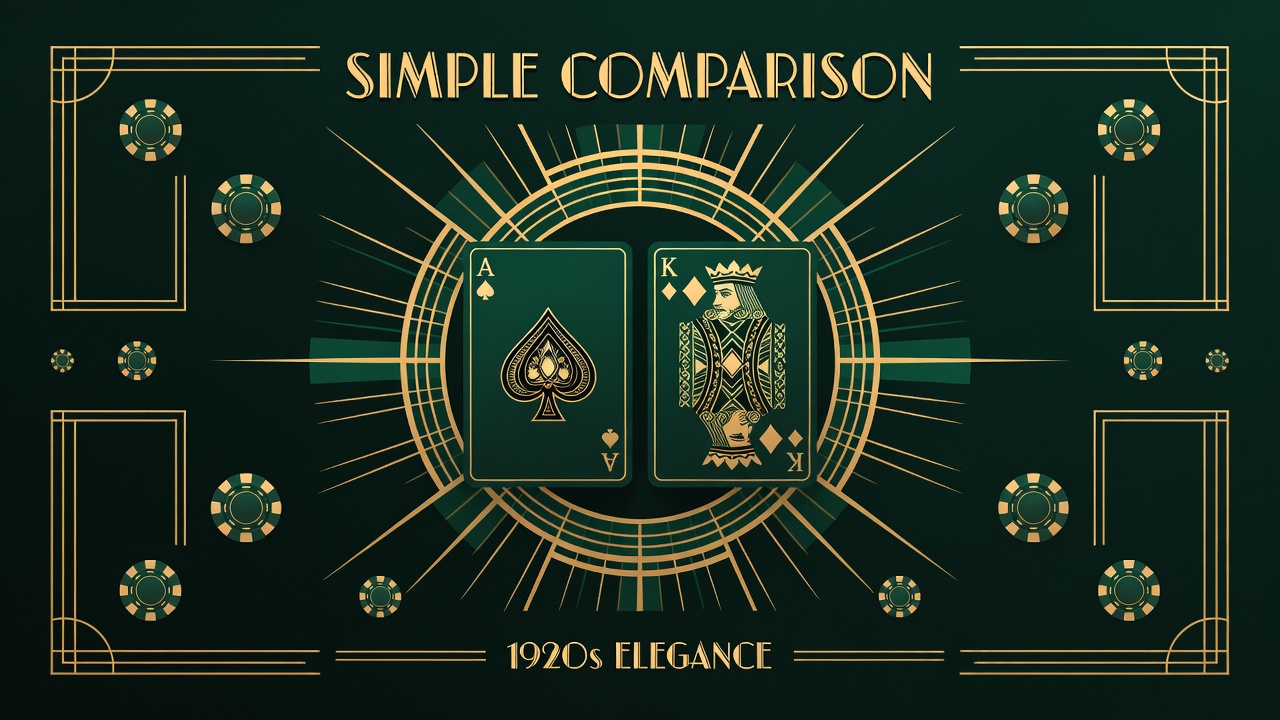
You sit at a table that looks like baccarat's shorter, less sophisticated sibling. The dealer deals two cards: one for the house, one for you. Higher card wins. That is the entire game. No strategy. No options beyond doubling down. No bluff, no variance in play. Just card meets card, the numbers are compared, and money moves.
How the Game Works
The casino knows this. They also know that a player who plays Casino War is a player who has already decided to lose money. You have opted out of skill. You have admitted that you want simplicity more than control. This is valuable information for a casino. It means they can count on you returning without improving your decision-making.
The appeal is obvious: anyone with fifth-grade arithmetic can play. The intimidation factor that keeps people away from blackjack (hit or stand, when? how?) does not exist. You cannot make a mistake. The mistake is built into the game itself, hardwired into the mathematics.
A regular deck, fifty-two cards. Thirteen ranks. The probability that your card beats the dealer's card is forty-eight percent (ignoring ties). A tie triggers a "war": you put up an additional bet, three cards are burned, and you play one more round. The player wins the war about forty-nine percent of the time. Over many hands, the house takes between two and three percent. This is not terrible by casino standards. It is not good by player standards.
Where Casino War gets you is the war bet itself. You are encouraged to "defend" your tie. The payout is three to one if you win the war. It feels generous. It is not. You are betting 2 to win 2, statistically speaking, with a house edge baked in. Players see the three to one payout and think they are getting a deal. They are not; they are getting sold a story.
The cardinal sin of Casino War is how it abuses the player who is already losing. If you lost the first hand, you sit out and wait. If you tied (roughly one in thirteen hands), suddenly you are in a decision: raise your bet and fight, or surrender and lose half your original bet. This is a classic behavioral trap. You have already committed money; you are offered a way to get some back. The rational move is to fold and accept the loss. But players double down, and the house edge on that decision is still moving against them.
Casino War is the game you play when you want the experience of gambling without the cognitive load. You want to be in the room, among people, with chips in front of you, but you do not want to learn anything or make meaningful decisions. It is the democracy of gambling: everyone is equal because no one is trying. It is also the casino's best friend, because a player at Casino War is a player who has already decided they do not mind losing.
Casino War exists because humans love simplicity over complexity. It is the game for people who want to gamble without thinking. The house loves these players because they never optimize their decisions.