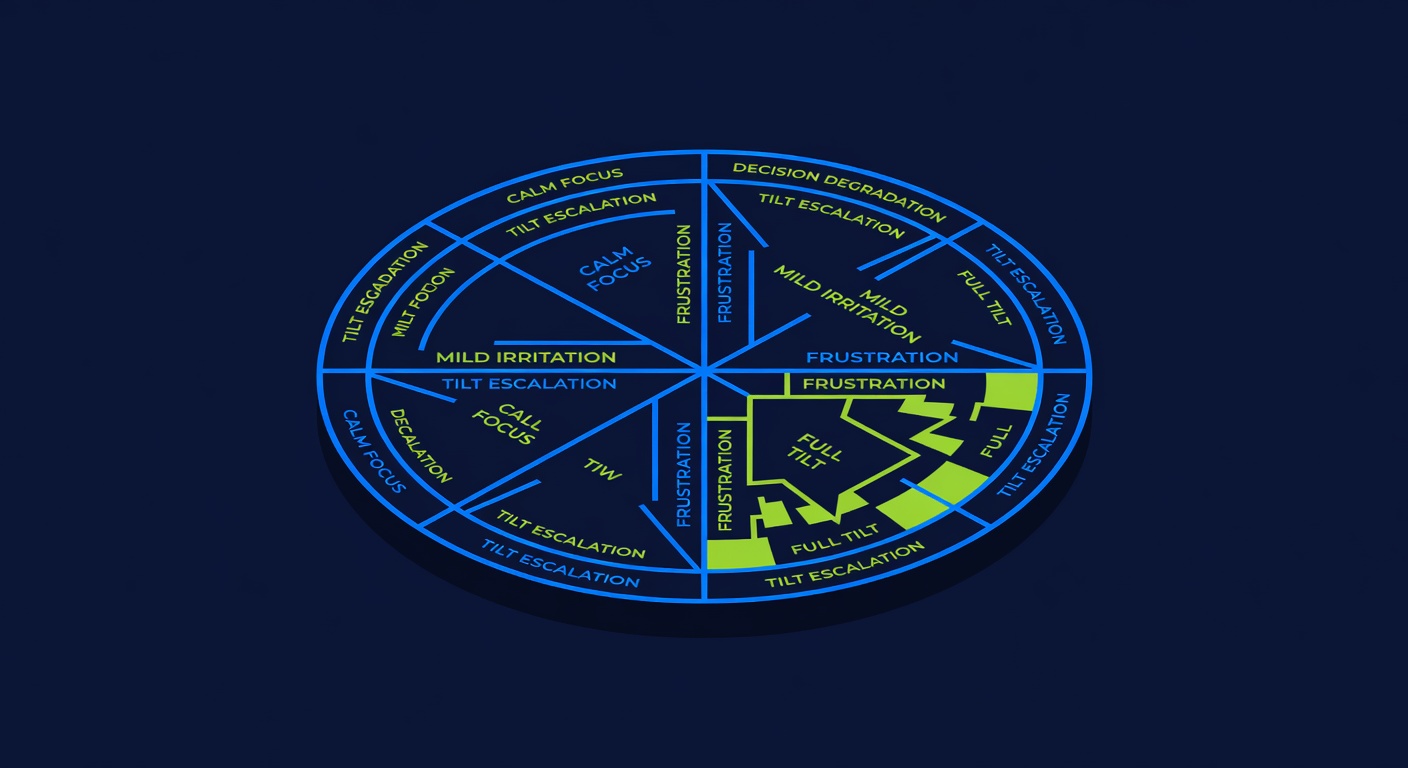
Tilt is fundamentally a question about how a player values the present moment relative to the future. A rational player in a poker game is trading short-term emotional comfort (winning this hand, beating this opponent, proving their skill) for long-term value (preserving bankroll, maintaining win rate, staying in the game).
When a player tilts, they are choosing to maximize present-moment satisfaction at the expense of fut
When a player tilts, they are choosing to maximize present-moment satisfaction at the expense of future value. They are making a temporal misprice. They are acting as though the next hand matters more than the next thousand hands. This is economically irrational only if the player has truly infinite time to play. If the player is finite (which all players are), the irrationality becomes clearer: they are burning through what little bankroll they have in service of winning one hand.
Consider a player down 2000 dollars with a 5000 dollar bankroll. The rational response is to tighten your play significantly. You are now one bad downswing away from ruin. The marginal utility of the remaining 5000 dollars is high. Each dollar matters more. You should be more conservative.
But a tilted player does the opposite. They loosen their play. They bet larger. They chase losses. Why? Because they are discounting the future heavily. The pain of the present loss (being down 2000) is so immediate that the possible pain of future ruin is weighted as less important. In economic terms, the tilted player has a very high subjective discount rate. They care almost exclusively about the next moment.
How do you combat this? By pre-committing to a time preference that you choose in advance, before emotion arrives. Set a loss limit before you play. If you lose that amount, you stop. You have now essentially removed the decision point. You cannot tilt into a larger loss if you have already decided to leave. The future has been pre-decided.
Second: understand that bankroll preservation is itself an investment that generates returns. A 5000 dollar bankroll that stays intact because you left the game is worth more than a 3000 dollar bankroll because you stayed and lost 2000. The 5000 dollars can be deployed tomorrow and tomorrow and tomorrow. The 3000 dollars is a smaller instrument. You are not losing money by leaving; you are preserving an asset that generates future value.
Third: recognize that the marginal value of playing one more hand decreases dramatically as you lose. The first hand you play is worth your full edge. The hundredth hand you play after a downswing is worth your edge minus the psychological premium you are paying in tilt. Often, the marginal hand has negative value due to tilt.
Therefore: control tilt by understanding that you are making a decision about time. A rational player prioritizes long-term value over short-term comfort. A tilted player does the opposite. The simplest solution is pre-commitment: decide in advance how much you are willing to lose, and then stick to that decision even when emotion suggests otherwise.